
The lesson
Frame a technical guide as buyer questions first, then show how your product answers those questions in the workflow.
The move
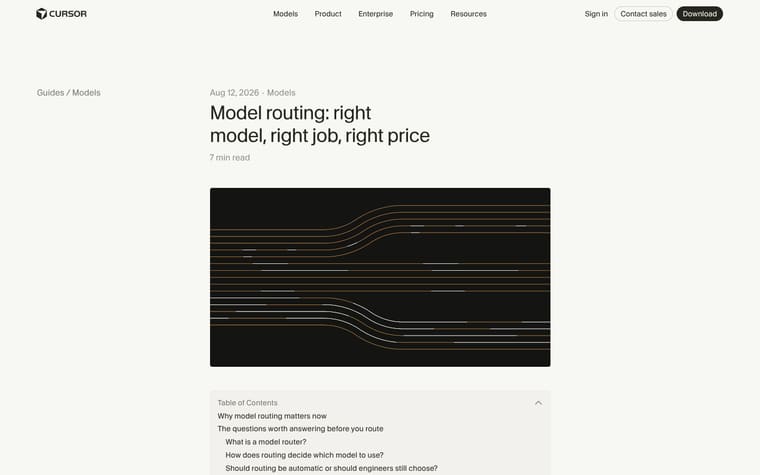
The guide opens with "AI code review: more context, fewer bugs", an "8 min read" label, and a table of contents built from questions such as "What is AI code review?" and "Does AI code review replace human review?" It starts with the shift in code review volume, citing Cursor session data and changes like lines added per PR up about 2.5x year over year. The middle sections define good and weak AI review with comparison blocks such as "Diff only" versus "Full context", then cover noise, measurement, local review, PR review, and whether review should live in the same product as the agent. The product section, "How to run AI code review in Cursor", maps "Local", "Pull request", and "Fix loop" to Agent Review, Bugbot, and Cursor or Cloud Agent.
Why it works
- Our readQuestion headings let an evaluator jump directly to the objections they already have before adopting AI code review.
- Our readThe comparison blocks turn abstract claims about context into a visible split between a weak reviewer and a useful reviewer.
- Our readThe workflow table connects the educational argument to Cursor without making the whole guide read like a product page.
What not to copy
Don't copy Cursor's code review data, Bugbot metrics, or agent workflow names. Keep the sequence of problem shift, buyer questions, comparison blocks, and a final workflow that shows where the product fits.
More from Cursor



More content marketing


Steal it for your brand.
Tell us what you want to make. We’ll talk through how to put these ideas to work for your brand.