The lesson
Give skimmers the challenge, solution and benefit first, then use the body to show the operational mess your product removed.
The move
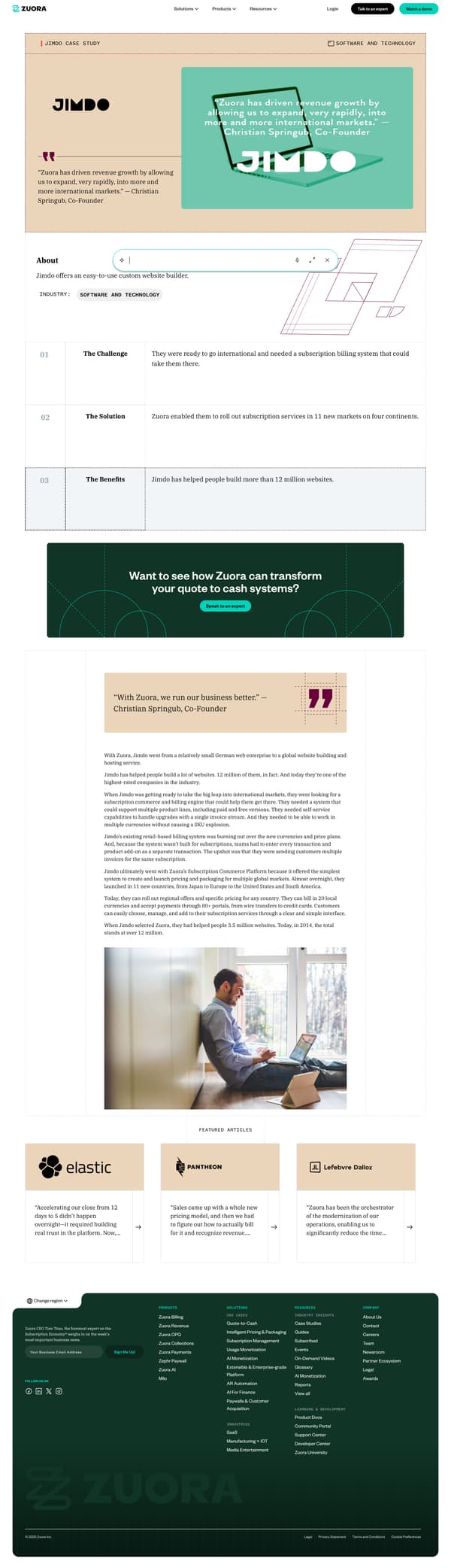
The page opens with “JIMDO CASE STUDY,” the industry label “SOFTWARE AND TECHNOLOGY,” the Jimdo logo and a founder quote about expanding into international markets. A short “About” line is followed by three numbered blocks, “The Challenge,” “The Solution” and “The Benefits,” then a CTA asking, “Want to see how Zuora can transform your quote to cash systems?” The narrative repeats the founder endorsement, explains how Jimdo’s retail-based billing system struggled with currencies, price plans, subscriptions and separate transactions, then describes why Jimdo chose Zuora’s Subscription Commerce Platform. It closes by stating that Jimdo launched in 11 new countries, can bill in 20 local currencies, accept payments through 80+ portals, and grew from helping people build 3.5 million websites to over 12 million in 2014.
Why it works
- Our readThe top summary gives the customer, industry, quote, company context, challenge, solution and benefit before the longer story begins.
- Our readThe story makes the billing pain concrete with multiple product lines, upgrades, currencies, SKU growth and multiple invoices for the same subscription.
- Our readThe expansion proof stays tied to operating capabilities, including new markets, local currencies and payment portals, not just a generic growth claim.
What not to copy
Don't copy Jimdo's website builder context, the Subscription Commerce Platform name, or the exact international market and payment details. Keep the structure of an executive quote, a three-part summary, a concrete billing problem, the chosen platform, and operating proof tied to the customer's expansion.
More from Zuora




More case studies








Steal it for your brand.
Tell us what you want to make. We’ll talk through how to put these ideas to work for your brand.