Pitch deck examples
The seed, Series A and demo day decks founders still copy, and the outlines investors wrote.
The presentations
- Seed pitch deck
Airbnb pitch deck (2009)
The most copied seed deck: one slide per question, with the market math done in three plain steps.
- Series B pitch deck
LinkedIn Series B pitch deck (2004)
How to pitch a later round on a thesis when your data is not there yet.
- Pre-seed concept deck
Uber pitch deck (2008)
A pre-product concept deck that sells a sharp positioning line and a timing bet on smartphones.
-
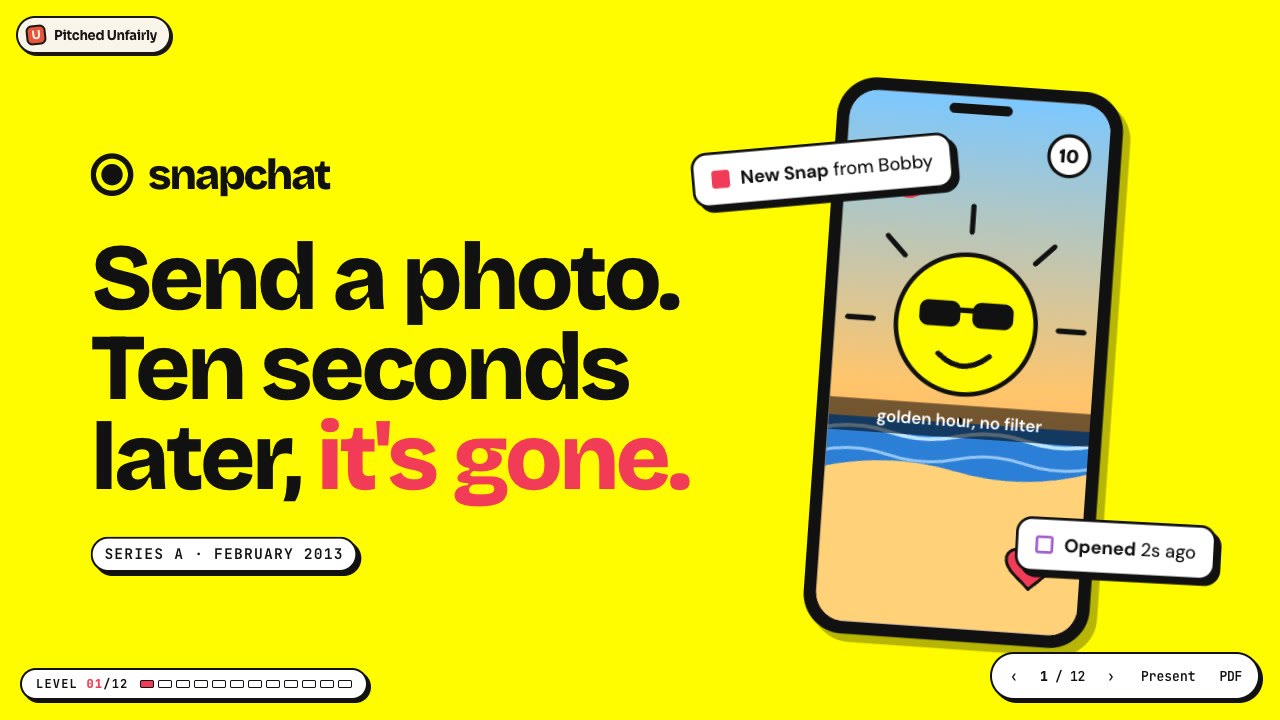 Series A pitch deck
Snapchat pitch deck (2013)
Ten seconds, then gone. Facebook wanted it anyway.
- First venture round pitch deck
YouTube's 2005 pitch deck to Sequoia
Ten short slides that sold a video site on the problem of sharing big files and one strong usage chart.
- Pre-seed convertible note deck
Intercom's first pitch deck
Eight slides that lead with the team because the team was the asset.
- Seed pitch deck
Buffer's seed deck and the founders' write-up
An average-looking deck built around one great traction slide and a competition slide that ended a recurring objection.
- Series A pitch deck
Front's Series A deck and Mathilde Collin's notes
A SaaS Series A deck that sells capital efficiency and expansion revenue, with the founder's own list of what she missed.
- Demo day and seed deck
Coinbase's YC Demo Day and seed deck
A rough demo day deck saved by two traction charts: signups, then real transactions.
- Series B deck pair
Pitch's Series B story deck and data deck
Split the raise into two decks: a story you narrate and a data deck investors read alone.
- Monthly investor update
Elad Gil's investor update format
Asks at the top, then numbers, then news. Built for investors who read the first lines on a phone.
The playbooks
- Monthly investor update
The investor update template (Visible and YC's Aaron Harris)
Same metrics every month, a candid lowlight, and one or two asks an investor can act on in a minute.
- Pitch outline (official guidance)
Sequoia's business plan outline for founders
The ten-part outline most seed decks still copy. Start here when you need the plain order of the argument.
- Seed deck template (official guidance)
YC's seed deck template
A seed deck that teaches by example: every slide is both the advice and a sample of it.
- Pitch outline (official guidance)
Michael Seibel's order for pitching a startup
Seven plain parts: what you do, how big, how far, what you know, how you earn, who, and the ask.
- Demo day pitch (official guidance)
YC's Demo Day pitch structure and slide rules
Seven beats, seven slides, minimal words. Lead with traction if it is your strongest card.
- Pitch outline (author guidance)
Guy Kawasaki's 10/20/30 rule for pitch decks
Ten slides, twenty minutes, thirty-point type. The constraint does the editing for you.
- Deck structure research (platform data)
DocSend's research on how investors read pitch decks
Data on what investors actually read in a sent deck: front-load the reason to keep going.
- Bridge or extension pitch (investor guidance)
How to pitch a bridge or extension to existing investors
A bridge pitch that names what went wrong, the one milestone the money buys, and what changes now.
Slides these decks use
Pitch deck templates
Steal it for your brand.
Tell us what you want to make. We’ll talk through how to put these ideas to work for your brand.