Snapchat pitch deck (2013)
Ten seconds, then gone. Facebook wanted it anyway. Snapchat's series a deck, 2013, and its structure.
The structure
- 01One-line promise
Show the product's one rule in a sentence and a picture.
- 02Problem
Name the pressure everyone feels and nobody says out loud.
- 03Insight
The counterintuitive bet, set side by side with the old way.
- 04Live demo
Let the room use the product for ten seconds.
- 05Objections
Put the skeptics on the slide, then the user who proves them wrong.
- 06Traction
One usage number, plotted over time, with the milestones marked.
- 07Engagement
Prove the habit: daily use, opens a day, retention.
- 08Competition
Show the biggest player copying you, and what happened next.
- 09Why a company
Explain why this is a new behavior and not a feature.
- 10Team
How few people are carrying how much load.
- 11The ask
The amount, the lead, and the two things the money buys.
- 12Kicker
Leave them with the stakes: what this is worth if it works.
What really happened
- Spring 2011: Evan Spiegel pitches disappearing photos as a Stanford product design class project; classmates call it a bad idea
- July 2011: the app launches on iPhone as Picaboo; it is renamed Snapchat a few months later
- Early 2012: teenagers find it; a Lightspeed partner hears about it from his daughter at the kitchen table
- April 2012: Lightspeed leads a $485,000 seed round
- October 2012: about 20 million snaps a day, and an Android app
- December 2012: video snaps ship; Facebook launches Poke, a near copy, which tops the charts and then sinks
- February 2013: Benchmark leads a $13.5M Series A; 60 million snaps a day, a team of ten
- November 2013: Snapchat reportedly turns down an all-cash offer from Facebook of about $3 billion
Use this template
Ten seconds, then gone. Facebook wanted it anyway. Our 12-slide rebuild, playable. Rebuilt from the record.
 Play the rebuild ▶
Play full screen →Make it in your brand ↓
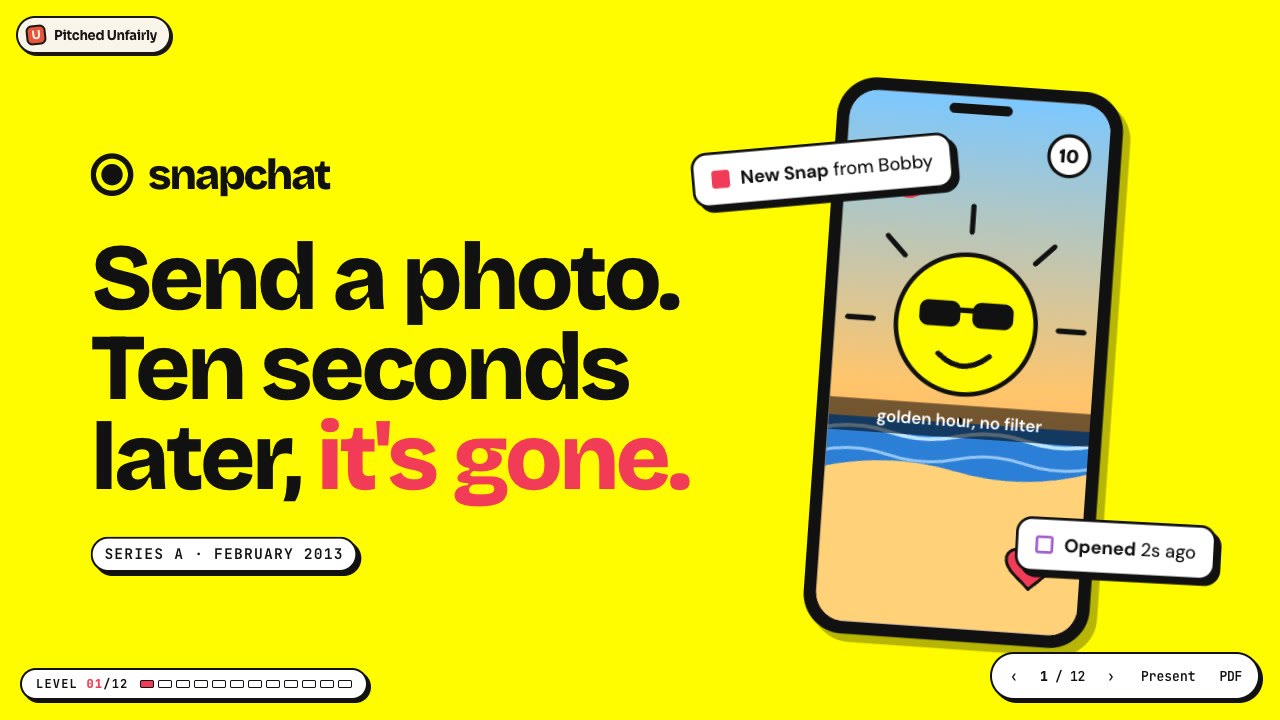
 01Send a photo. Ten seconds later, it's gone.
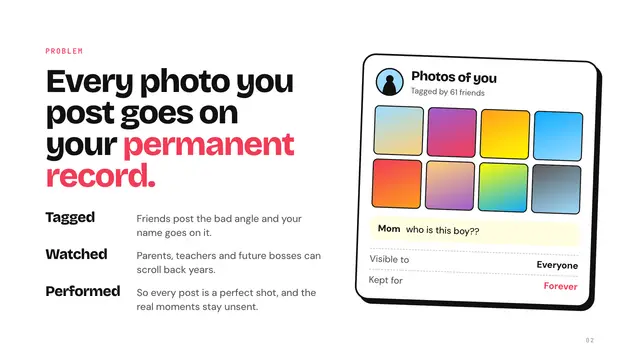 02Every photo you post goes on your permanent record.
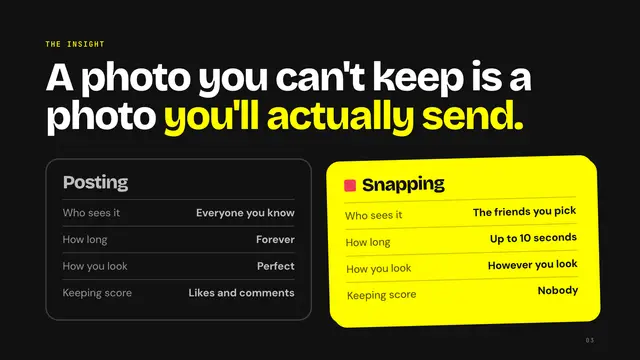 03A photo you can't keep is a photo you'll actually send.
 04You get ten seconds with this snap. Then it's gone for good.
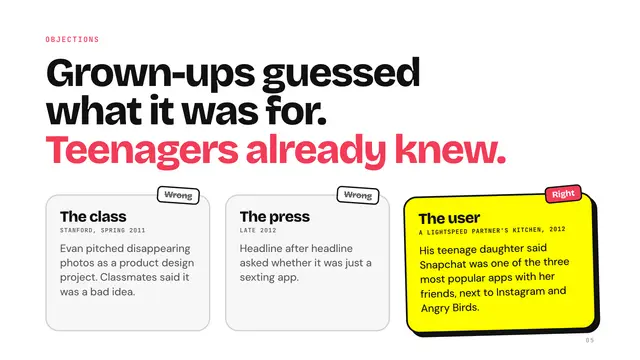 05Grown-ups guessed what it was for. Teenagers already knew.
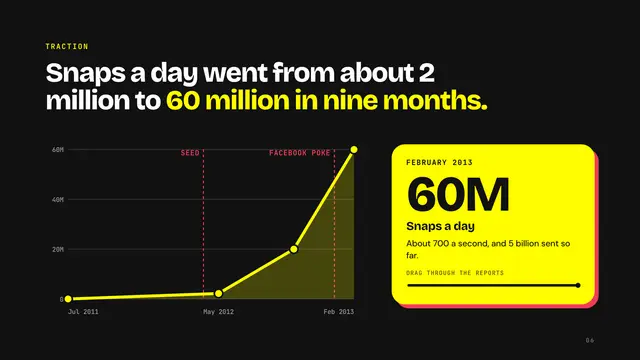 06Snaps a day went from about 2 million to 60 million in nine months.
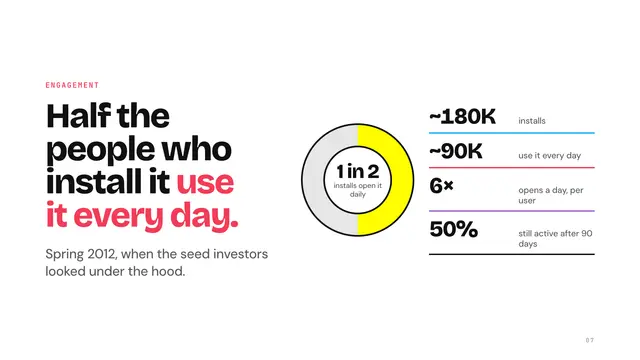 07Half the people who install it use it every day.
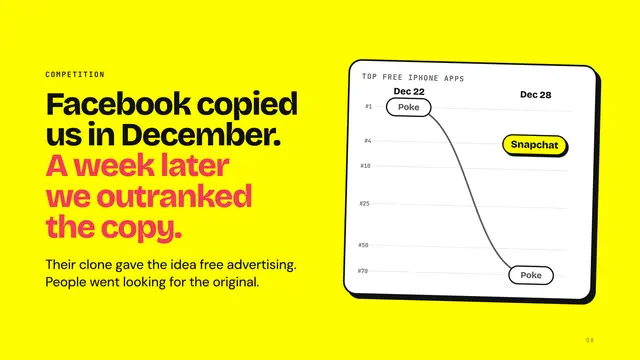 08Facebook copied us in December. A week later we outranked the copy.
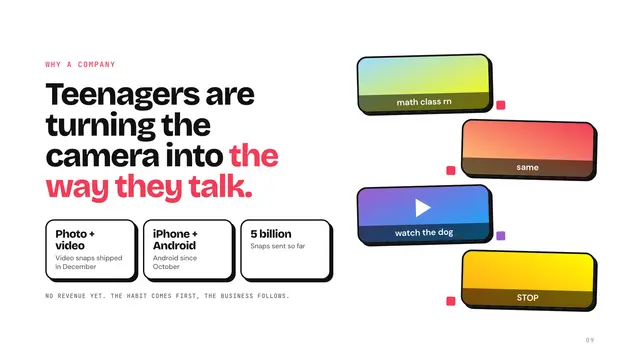 09Teenagers are turning the camera into the way they talk.
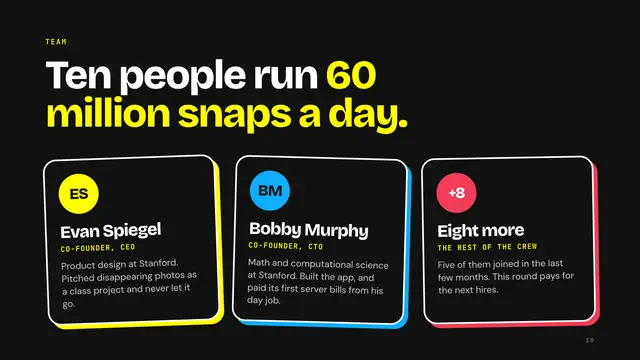 10Ten people run 60 million snaps a day.
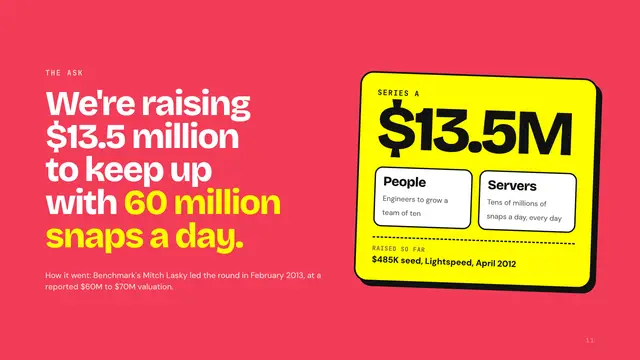 11We're raising $13.5 million to keep up with 60 million snaps a day.
 12Facebook slid in with about $3 billion. Snapchat said no.
Make it in your brand
Type your site. We build it on Snapchat's structure, in your brand.
Source: TechCrunch on the Benchmark round, February 2013. The rebuild is our own take, not affiliated with Snapchat.
More pitch decks
- Monthly investor update
The investor update template (Visible and YC's Aaron Harris)
Same metrics every month, a candid lowlight, and one or two asks an investor can act on in a minute.
- Pitch outline (official guidance)
Sequoia's business plan outline for founders
The ten-part outline most seed decks still copy. Start here when you need the plain order of the argument.
- Seed deck template (official guidance)
YC's seed deck template
A seed deck that teaches by example: every slide is both the advice and a sample of it.
Steal it for your brand.
Tell us what you want to make. We’ll talk through how to put these ideas to work for your brand.