The lesson
Use the approach section to connect each product capability to a specific customer workflow before you show results.
The move
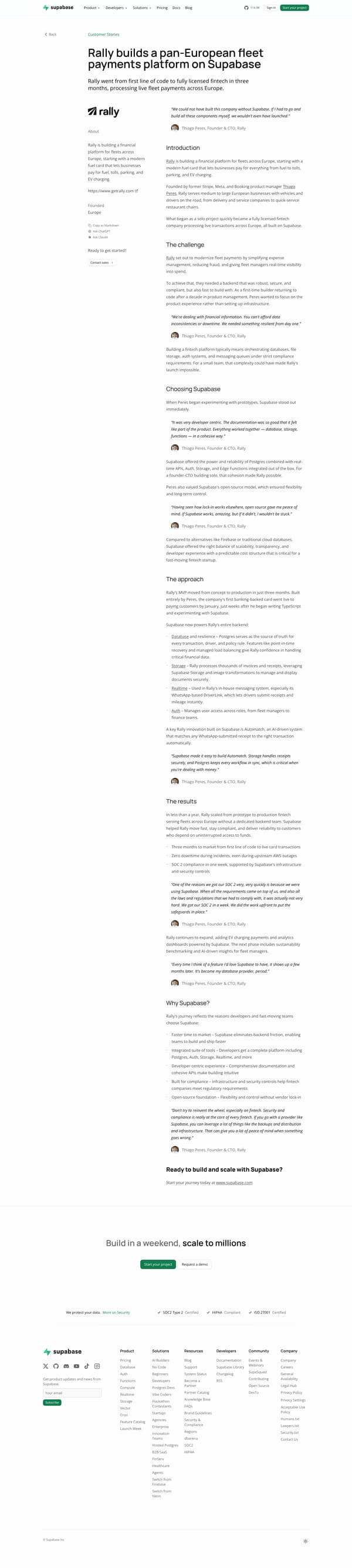
The story opens with the title “Rally builds a pan-European fleet payments platform on Supabase,” a short subhead about going from first line of code to fully licensed fintech in three months, and a quote from Thiago Peres. A left column gives the Rally logo, “About” copy, website, “Founded,” and “Europe,” while the main column moves through “Introduction,” “The challenge,” “Choosing Supabase,” “The approach,” and “The results.” The approach section lists how Supabase powers Rally's backend, including “Database and resilience,” “Storage,” “Realtime,” and “Auth,” then names Automatch as a Rally innovation. The results section gives three callouts: “Three months to market,” “Zero downtime during incidents,” and “SOC 2 compliance in one week,” followed by “Why Supabase?” and a final build prompt.
Why it works
- Our readThe opening says Rally went from first line of code to fully licensed fintech in three months, so the reader gets the main business change before the story starts.
- Our readThe left rail gives Rally's product, site, founded status, and region, which keeps the main column free for the narrative.
- Our readThe approach section maps Supabase features to Rally jobs, from Postgres as the source of truth to Storage, Realtime, Auth, and Automatch.
What not to copy
Don't copy Rally's fleet payments market, Automatch name, DriverLink, or fintech compliance story. Keep the structure of a founder quote, customer context in a side rail, problem, selection reason, product-to-workflow mapping, and customer-owned results.
More from Supabase



More case studies








Steal it for your brand.
Tell us what you want to make. We’ll talk through how to put these ideas to work for your brand.