The lesson
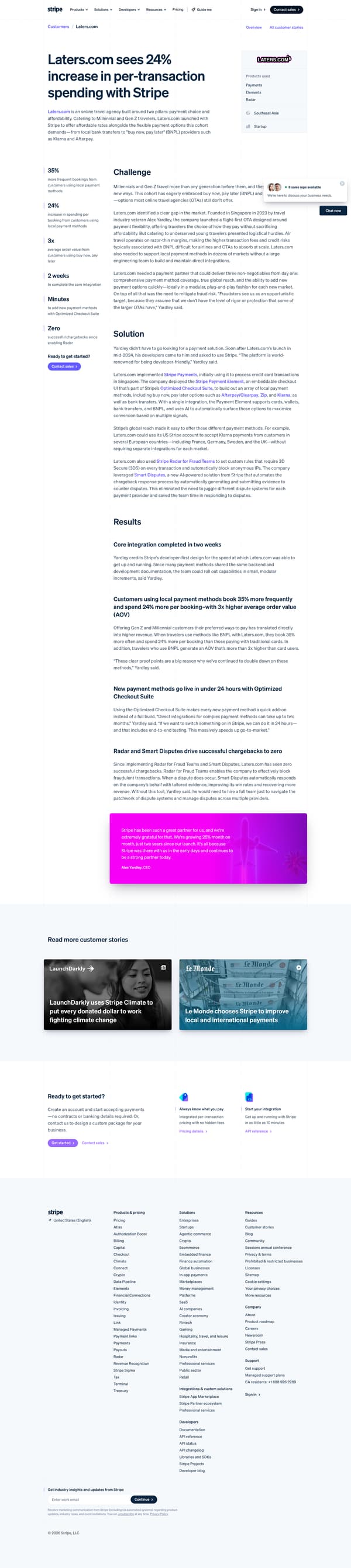
Lead with the strongest customer outcome, then use a metric stack to show the product changed more than one part of the business.
The move
The page opens with the title “Laters.com sees 24% increase in per-transaction spending with Stripe,” followed by a short summary of Laters.com as an online travel agency built around payment choice and affordability. A right-side card shows the Laters.com logo, “Products used” with Payments, Elements and Radar, plus Southeast Asia and Startup labels, while the body lists outcomes including “35% more frequent bookings from customers using local payment methods,” “3x average order value from customers using buy now, pay later,” and “Zero successful chargebacks since enabling Radar.” The story then moves through “Challenge,” “Solution,” and “Results,” with quotes from Yardley and detail on Payment Element, local payment methods, Klarna, Radar for Fraud Teams, Smart Disputes and 3D Secure.
Why it works
- Our readThe headline uses the clearest commercial result, so the reader understands the customer change before reading the travel and payment context.
- Our readThe opening summary names the customer’s audience and payment methods, which makes the product fit easy to understand.
- Our readThe metrics block covers growth, speed, order value and fraud, so Stripe’s role is shown across conversion, integration and risk.
What not to copy
Don't copy the Laters.com travel-market gap, Millennial and Gen Z framing, named payment methods, or Stripe product names. Keep the structure of a result-led headline, a compact customer and product sidebar, a stack of concrete outcomes, and a Challenge, Solution, Results story.
More from Stripe


More case studies








Steal it for your brand.
Tell us what you want to make. We’ll talk through how to put these ideas to work for your brand.