The lesson
Lead with the operational metric the buyer cares about, then use the customer’s engineers to show how the system changed daily work.
The move
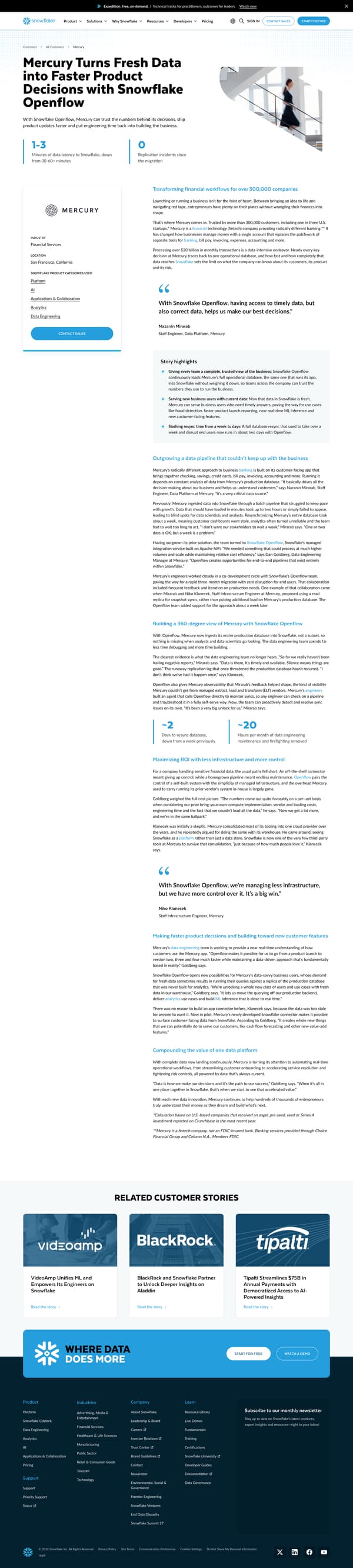
The page opens with the title “Mercury Turns Fresh Data into Faster Product Decisions with Snowflake Openflow,” a short summary, a cropped customer image and two result callouts: “1-3” minutes of data latency and “0” replication incidents. It then lists industry, location and Snowflake product categories, introduces Mercury under “Transforming financial workflows for over 300,000 companies,” and anchors the stakes in a quote from Nazanin Mirarab. “Story highlights” gives three skim-ready bullets before the full narrative moves through “Outgrowing a data pipeline that couldn’t keep up with the business,” “Building a 360-degree view of Mercury with Snowflake Openflow,” and “Maximizing ROI with less infrastructure and more control.” Midway, more result callouts summarize “~2” days to resync the database and “~20” hours per month of data engineering maintenance and firefighting removed.
Why it works
- Our readThe first screen gives the buyer the outcome immediately with two quantified callouts, before the longer technical story begins.
- Our readThe customer context makes the data problem feel consequential by connecting one operational database to product, customer and risk decisions.
- Our readNamed engineers explain the tradeoffs, from batch pipeline limits to control, observability and managed infrastructure, which gives the story credibility for a technical reader.
What not to copy
Don't copy Mercury's banking context, Openflow co-development details or Apache NiFi positioning. Keep the structure of immediate quantified proof, customer context, named technical voices, story highlights and a problem-to-implementation-to-operating-change arc.
More from Snowflake
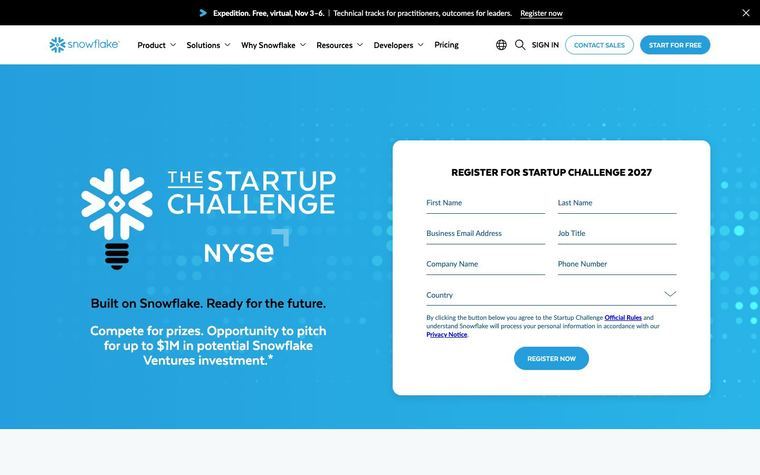




More case studies



Steal it for your brand.
Tell us what you want to make. We’ll talk through how to put these ideas to work for your brand.