The lesson
Compare against a vendor category by first naming why the bundled approach breaks down, then turn the rest of the page into an evaluation checklist.
The move
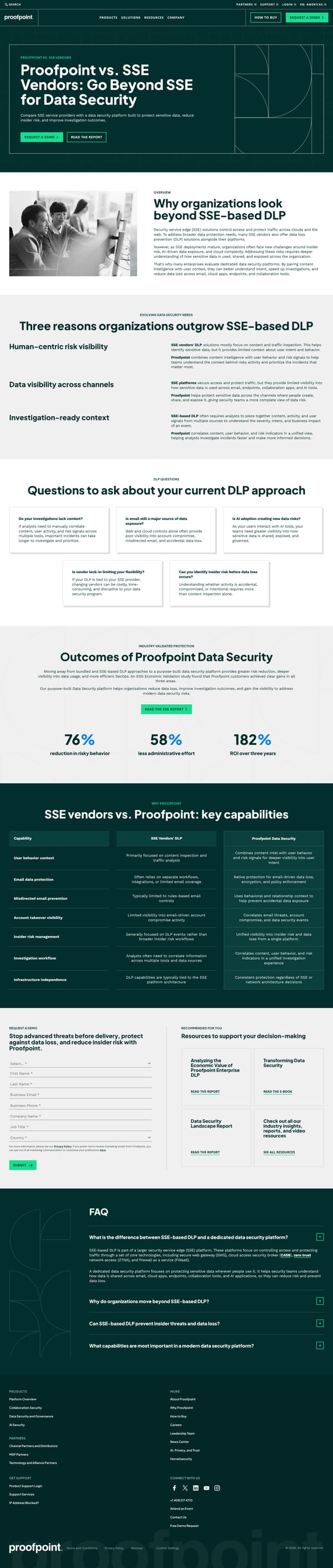
The page opens with “Proofpoint vs. SSE Vendors: Go Beyond SSE for Data Security,” a short promise to compare SSE service providers with a data security platform, and two actions: “Request a demo” and “Read the report.” It then explains “Why organizations look beyond SSE-based DLP,” followed by “Three reasons organizations outgrow SSE-based DLP” across human-centric risk visibility, data visibility across channels, and investigation-ready context. The next section asks “Questions to ask about your current DLP approach,” then adds “Outcomes of Proofpoint Data Security” with an ESG report callout and metrics including “76 % reduction in risky behavior,” “58 % less administrative effort,” and “182 % ROI over three years.” It closes the comparison with “SSE vendors vs. Proofpoint: key capabilities,” a side-by-side table covering user behavior context, email data protection, misdirected email prevention, account takeover visibility, insider risk management, investigation workflow, and infrastructure independence, followed by a demo form.
Why it works
- Our readThe hero frames the comparison around a category, not a single rival, so readers who are evaluating bundled SSE-based DLP can place themselves in the problem quickly.
- Our readThe middle section turns the argument into questions a buyer can ask of their current DLP approach, which makes the comparison feel like an evaluation checklist instead of only a product claim.
- Our readThe capability table uses short written cells for each side, so the reader can see how Proofpoint says the products differ in workflow, visibility, and architecture.
What not to copy
Don't copy the broad SSE-vendor framing or ESG metrics unless you can support them for your own category and product. Keep the sequence of category context, buyer diagnostic questions, third-party proof, then a written capability comparison.
More from Proofpoint
More landing pages








Steal it for your brand.
Tell us what you want to make. We’ll talk through how to put these ideas to work for your brand.