
The lesson
Build a competitor page around the situations buyers fear after signing, not just the features they compare before signing.
The move
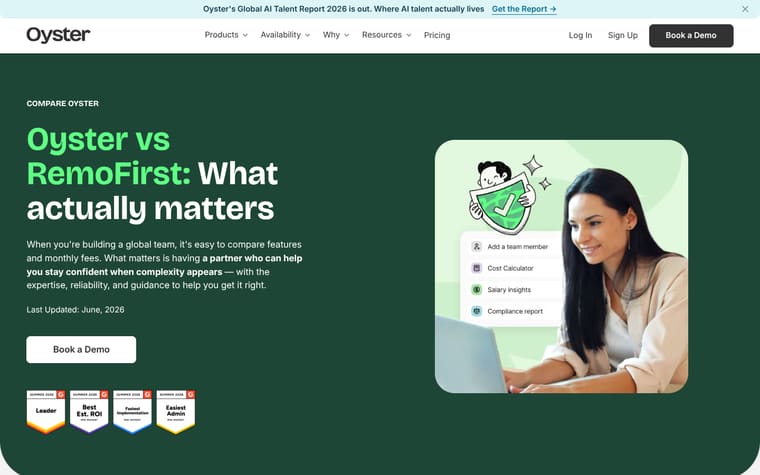
The hero leads with 'Oyster vs WorkMotion: What actually matters' and says the real comparison is expertise, reliability, and guidance, with a 'Book a Demo' action. It then lists why teams choose Oyster, followed by 'Who each option is best for' with separate bullets for Oyster and WorkMotion. The middle section, 'What actually matters when choosing an EOR', compares areas like support, pricing, compliance expertise, complex situations, employee experience, automation, and accountability. Lower down, expert proof, G2 quotes, buyer questions, and 'Our point of view' restate the thesis that global employment needs both technology and human expertise.
Why it works
- Our readThe page does not open with a feature checklist; it reframes the decision around what happens when complexity appears.
- Our readThe 'Who each option is best for' section gives WorkMotion a plausible fit, which makes the comparison feel less like a one-sided attack.
- Our readThe provider table turns each Oyster claim into a buyer question, so the reader leaves with a way to evaluate any EOR, not just WorkMotion.
What not to copy
Don't copy the EOR-specific claims about country specialists, deposits, offboarding, and local compliance unless those are real buying risks in your category. Keep the structure of reframing the comparison around post-purchase moments, then giving the buyer questions to ask any provider.
More from Oysterhr
More landing pages








Steal it for your brand.
Tell us what you want to make. We’ll talk through how to put these ideas to work for your brand.