The lesson
Turn a short customer story into an operating argument by naming the tradeoff the customer needed to rebalance.
The move
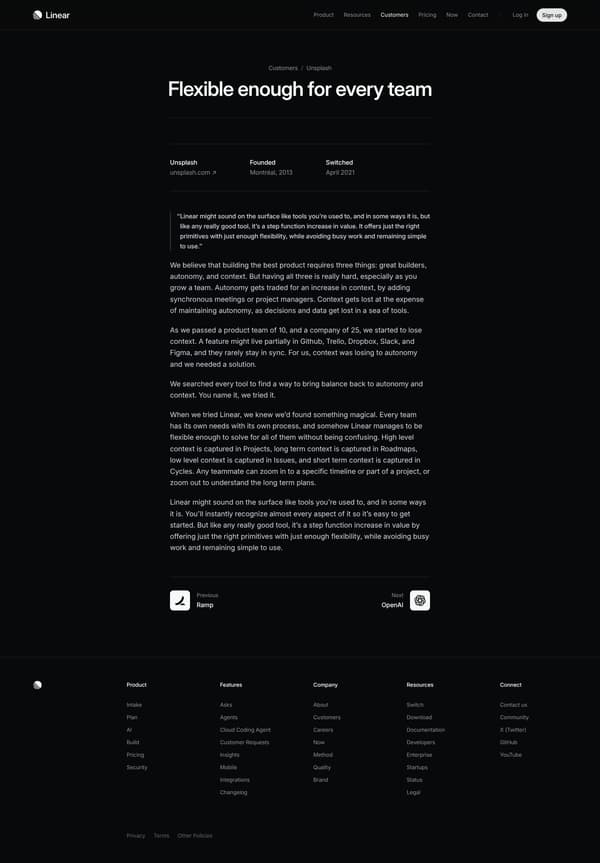
The page opens with the breadcrumb “Customers / Unsplash” and the title “Flexible enough for every team.” A compact facts row lists Unsplash, “Founded Montréal, 2013,” and “Switched April 2021,” followed by a pulled quote about Linear offering “just the right primitives.” The story then explains how autonomy and context became harder to balance as the company grew, with work split across Github, Trello, Dropbox, Slack, and Figma. It closes by naming the Linear structures that hold different kinds of context: Projects, Roadmaps, Issues, and Cycles.
Why it works
- Our readThe customer facts sit directly under the title, so the reader knows who Unsplash is, where it started, and when it switched before reading the story.
- Our readThe story frames the problem as a tradeoff between autonomy and context, which gives the tool choice a larger operating reason.
- Our readThe product explanation maps Linear objects to types of context, so the reader sees why Projects, Roadmaps, Issues, and Cycles matter.
What not to copy
Don't copy Unsplash's autonomy and context language, its named tool stack, or the phrase “step function increase in value.” Keep the short customer facts row, the first-person problem narrative, and the mapping from product primitives to the customer's work.
More from Linear



More case studies








Steal it for your brand.
Tell us what you want to make. We’ll talk through how to put these ideas to work for your brand.