The lesson
Lead with the customer’s conversion change, then show the exact data and workflow pieces that made the change believable.
The move
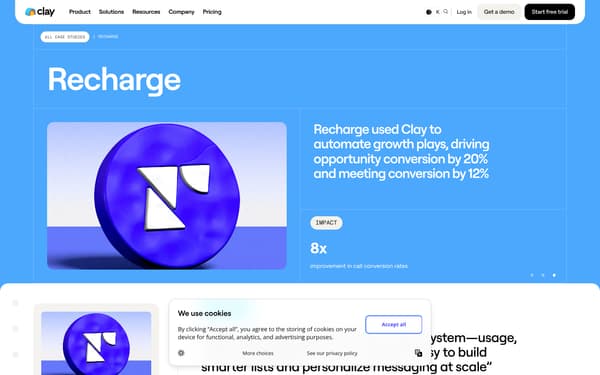
The page opens with “Recharge,” a large brand image, and the title “Recharge used Clay to automate growth plays, driving opportunity conversion by 20% and meeting conversion by 12%.” It puts three impact callouts near the top, then an “At a glance” section with a quote, company context, industry, headquarters, and a short summary of the problem and change. “The problem” explains how product, CRM, transaction, behavioral, sales, and third-party data sat across systems, slowing campaign creation and leaving teams dependent on hand-raisers. “The solution” shows Clay unifying audience building, AI-generated messaging, automated Outreach sequences, and example campaigns for acquisition, expansion, and churn.
Why it works
- Our readThe headline pairs the customer action with two conversion results, so the business outcome is clear before the reader reaches the story.
- Our readThe page names the data sources, tools, and campaign types, which makes the operating change feel concrete rather than like a generic automation claim.
- Our readThe structure moves from “At a glance” to “The problem,” “The solution,” and “Clay’s impact,” giving a skimmer the whole arc in predictable steps.
What not to copy
Don't copy Recharge's Shopify subscription billing context, named tools, or example campaign thresholds. Keep the structure of a quantified outcome headline, a data-fragmentation problem, a named operating workflow, and campaign examples across the customer journey.
More from Clay



More case studies








Steal it for your brand.
Tell us what you want to make. We’ll talk through how to put these ideas to work for your brand.