Quick and easy to learn
Beginners find the syntax clean; experienced programmers pick it up very quickly. Observed
Brand book
Python's brand is the interpreter. The site leads with runnable code, marks every link with ">>>", and lets the logo's two colours do the rest, so the brand feels like using Python rather than being sold it. Our reading

The colours inside the snakes (with permission) and the code sample shown; everything else on python.org is a fixed system
Source: python.org/psf/trademarks-faqs3.dualstack.us-east-2.amazonaws.com/pythondotorg-assets/media/files/Python-Logo-Usage-Guidelines-v1.0.pdf
Our engine's setting, built from their rules.
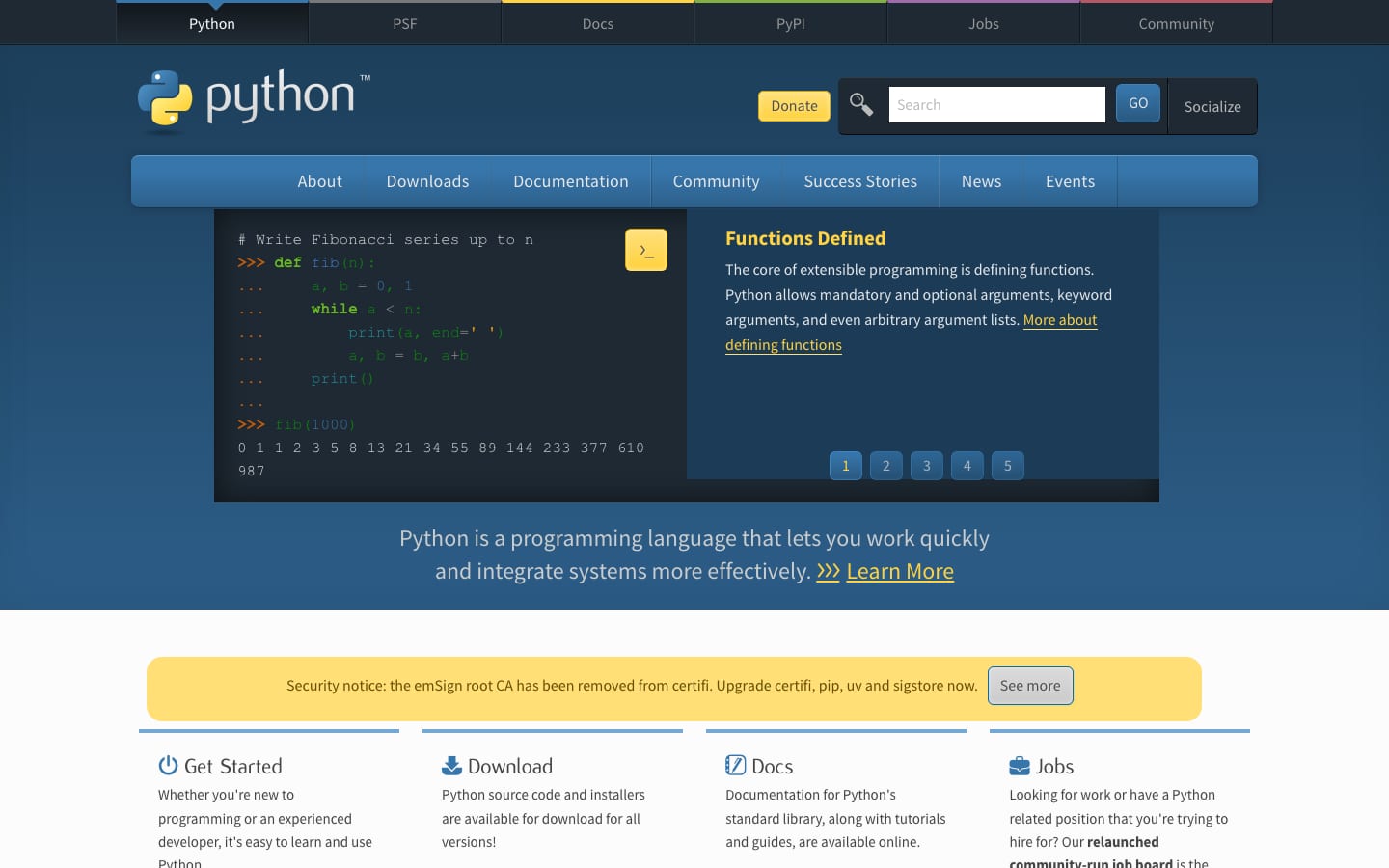
Cover the snakes. It should still read as python.org: blue gradient frame, yellow actions, ">>>" read-more links, a code panel, Source Sans text.
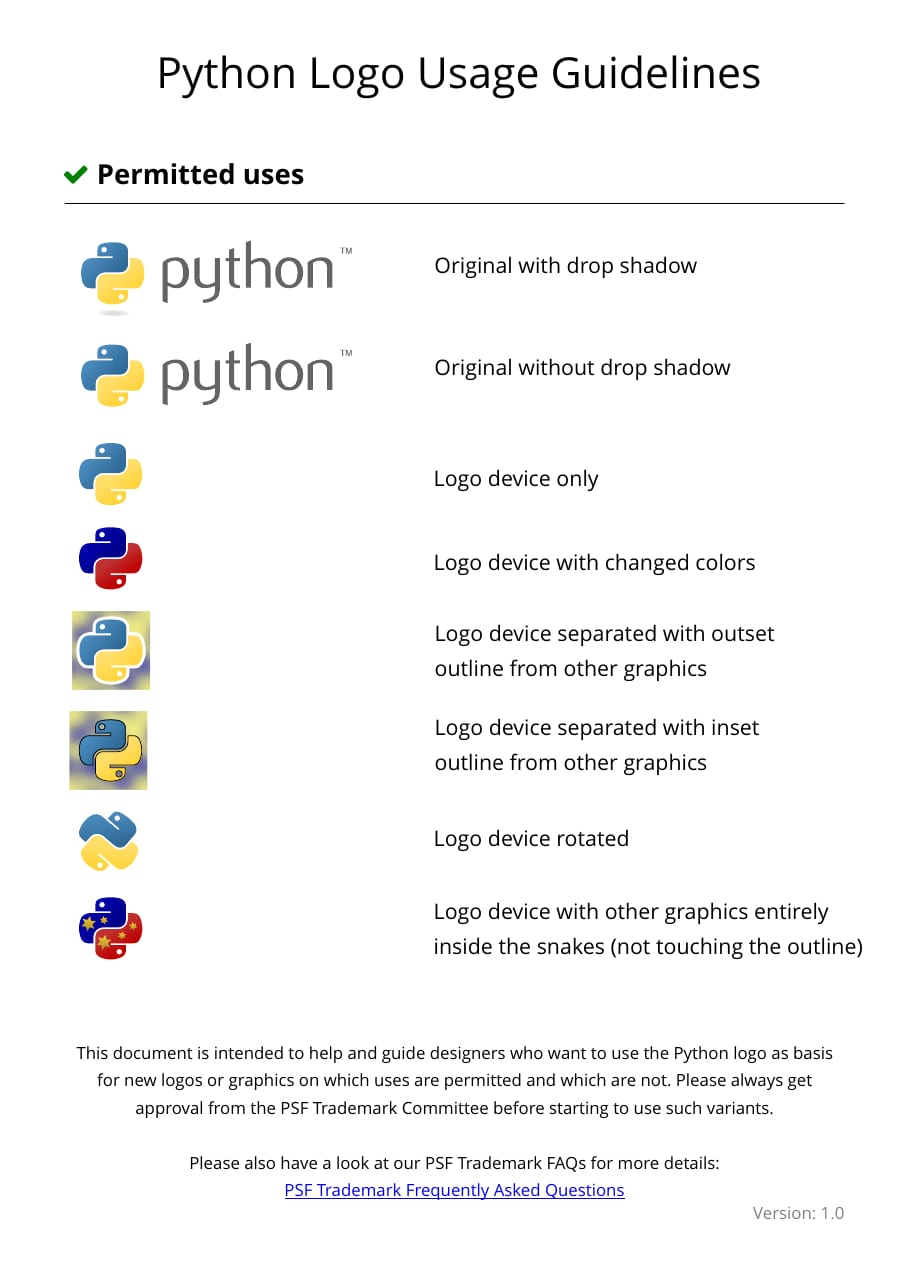
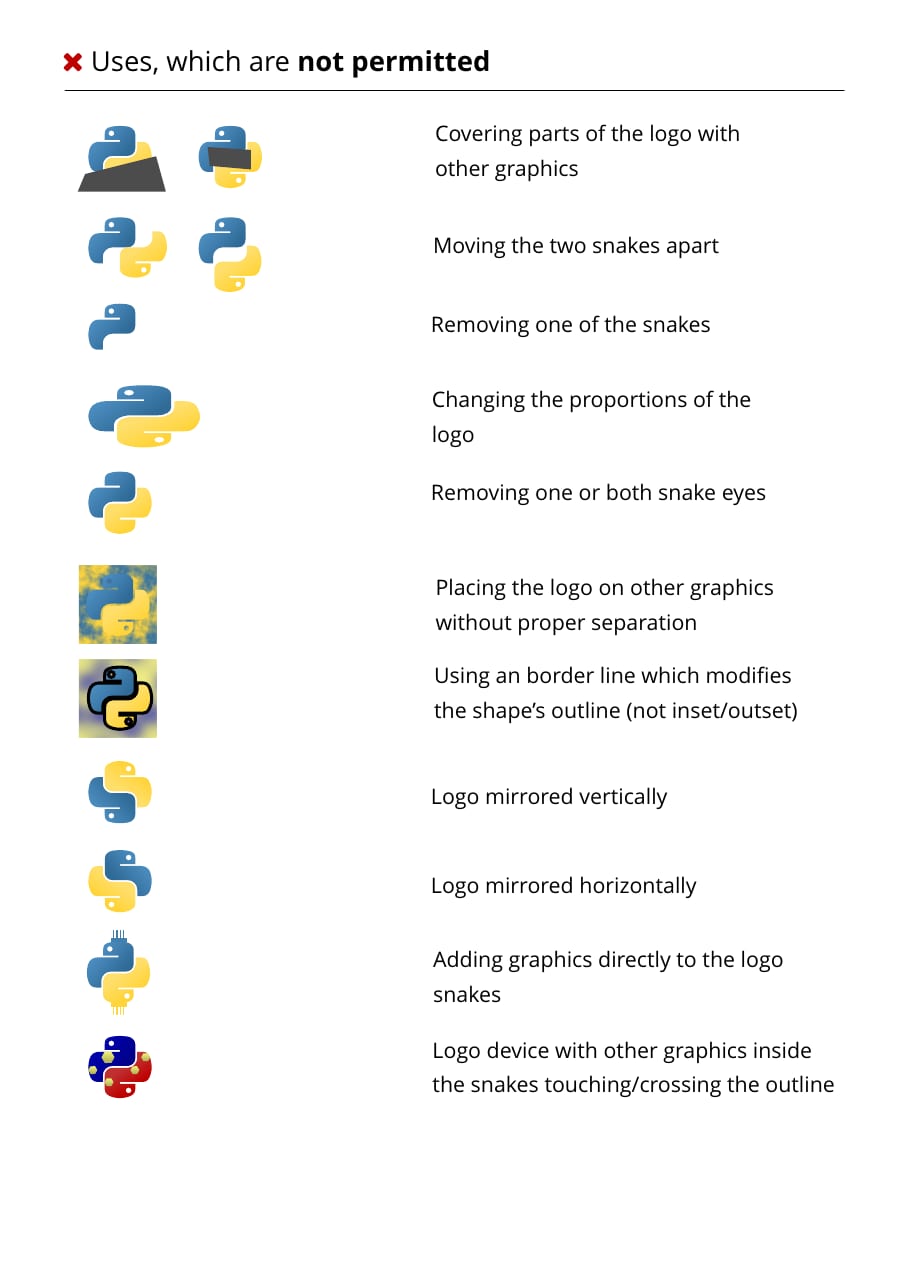
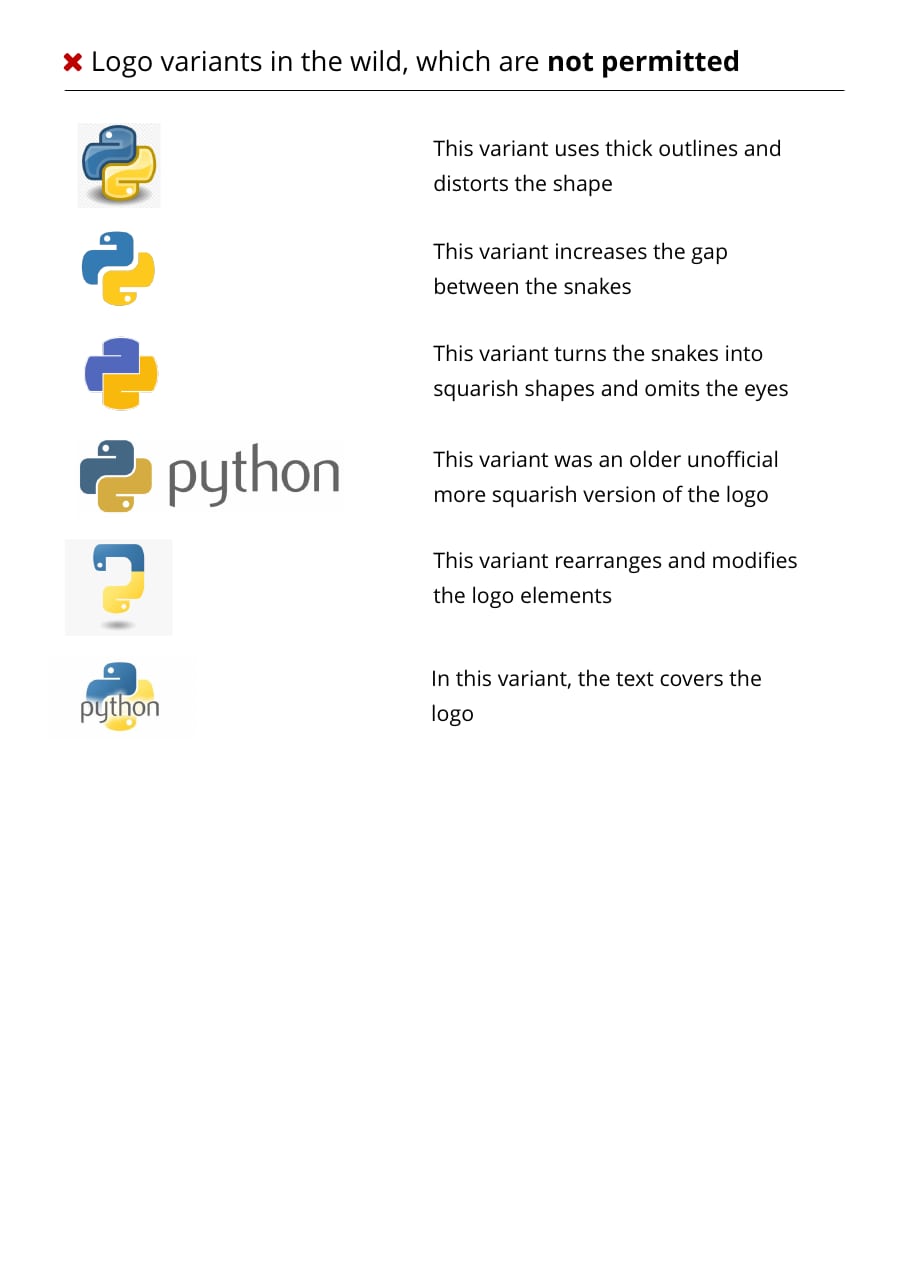
Flatten any logo use to one colour: the outline, gaps, chins and eyes must match the original exactly (the FAQ's own test).
TM on the logo, Python as an adjective, no implied endorsement, non-affiliation notice when needed.
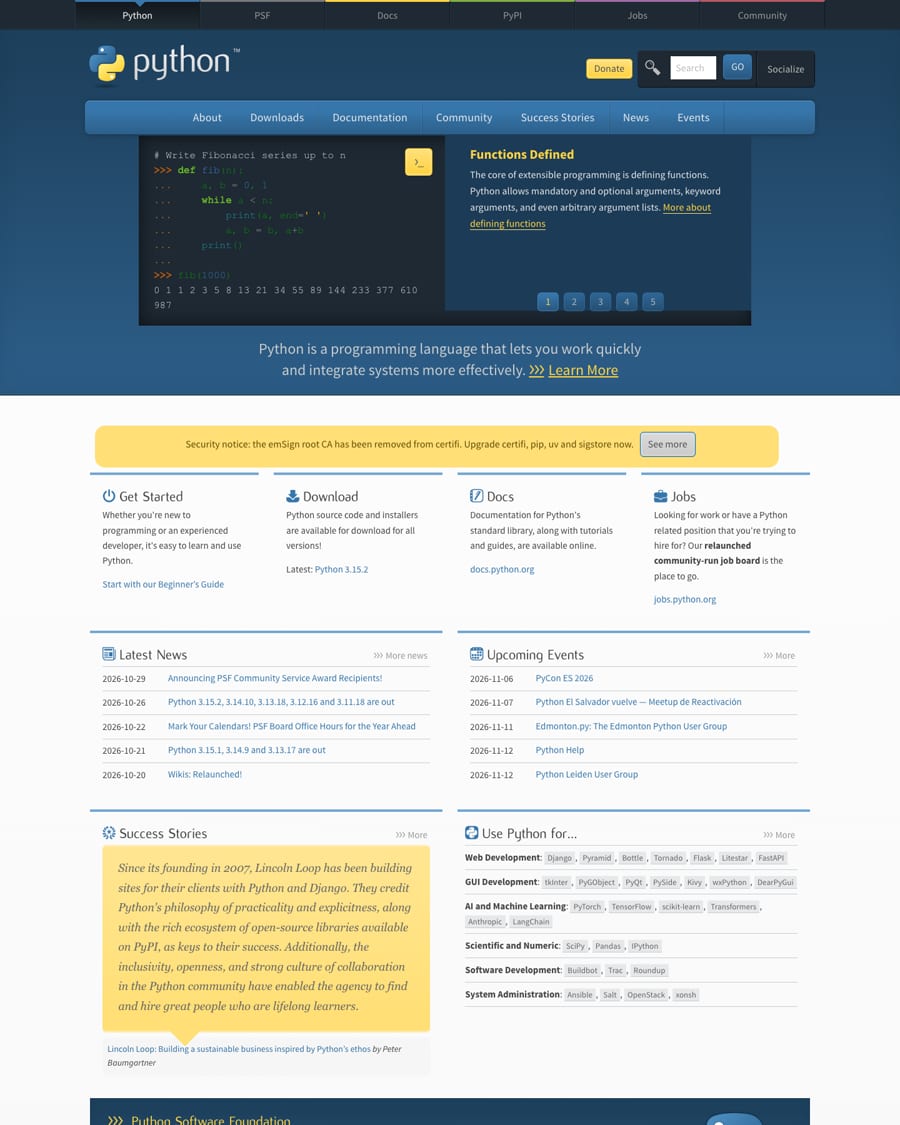
A programming language that lets you work quickly and integrate systems more effectively. Observed
Beginners find the syntax clean; experienced programmers pick it up very quickly. Observed
Simple syntax that emphasises readability, a fast edit-test-debug cycle and no compile step. Published
Web, GUI, AI and machine learning, science, software development and system administration, backed by PyPI. Observed
OSI-approved licence, usable commercially, stewarded by a non-profit foundation and its members. Published
Functions Defined
Quick & Easy to Learn
Get Started
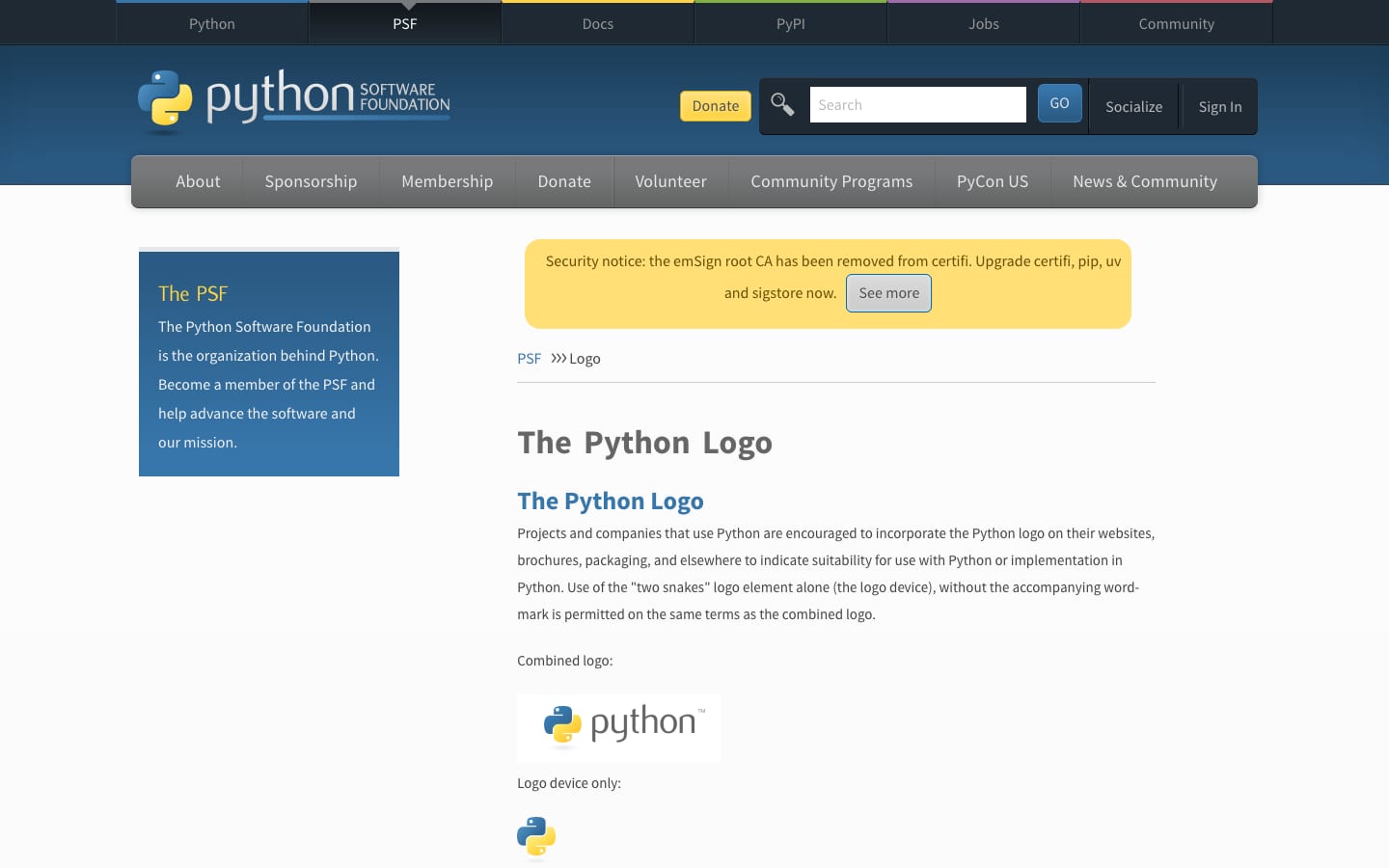
The PSF is a non-profit that holds Python's intellectual property, produces the free core distribution and protects the Python name; its mission statement was approved in 2002 and amended through 2009. The two-snakes logo was drawn by Tim Parkin around 2005, when Python moved from a "cute" animal icon to a mark balancing formality and playfulness, and he assigned it to the PSF. python.org has carried a copyright line since 2001.
Code is read more often than written; clarity wins (PEP 20 aphorism).
PublishedChoose the plain way; the docs echo it with economy of expression (PEP 20).
PublishedSay what you mean in code and in prose (PEP 20).
PublishedPart of the PSF mission; also why the docs ask for simple English and inclusive terms.
PublishedPSF licences keep the rights to obtain, use, redistribute and modify (paraphrase).
PublishedCategory. General-purpose, interpreted, high-level open source programming language Published
Other programming languages: experienced programmers "in any other language" are invited to switch (hero slide).
Python is an interpreted, object-oriented, high-level programming language with dynamic semantics, a clean, readable syntax and a large standard library, available free for all major platforms. It is developed under an OSI-approved open source license administered by the Python Software Foundation.
The homepage carries no slogan. It states one sentence (Python lets you work quickly and integrate systems more effectively), then proves it with code, a version number, news and a list of uses. The PSF adds its mission and two asks: become a member, donate.
Source: python.org/%20(2026-10-31)python.org/aboutpython.org/doc/essays/blurbpython.org/psf/mission
For example, use a with statement to close the file.
Warning: experts only, e.g. files may be lost.
Built with the Python programming language
Python your software today!
A world-wide, mixed-experience audience reads faster when the language is simple, affirmative and free of jargon or alarm.
PlainWelcomingConfidentPrecise
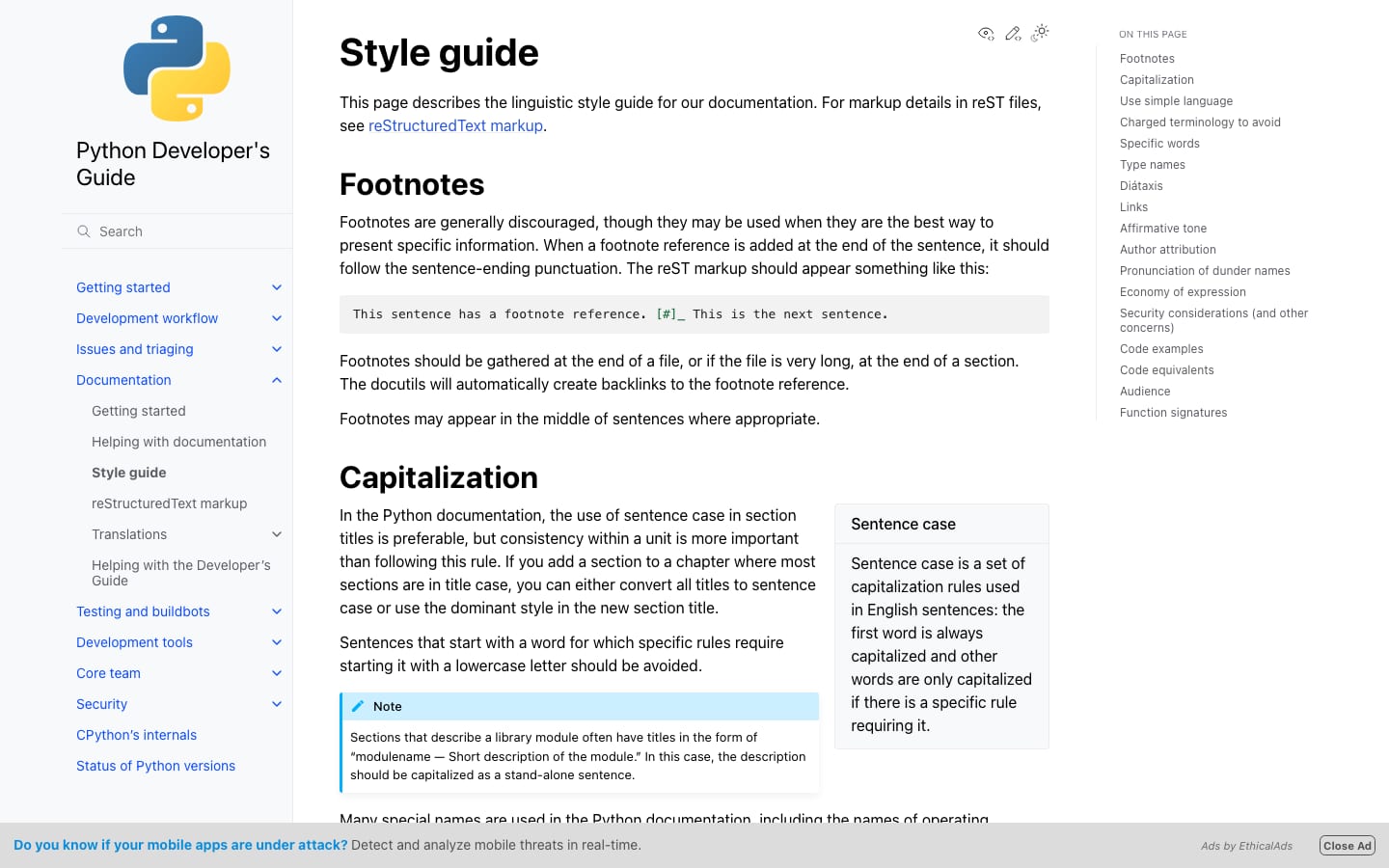
Python publishes writing rules for its documentation (devguide style guide) and, through PEP 20, the values behind them. The homepage voice is short, friendly and factual, with Title Case labels.
allowlistblocklistfree-threadedfor examplethat is
whitelistblacklistmaster/slavee.g.i.e.experts onlyNo-GIL
Source: peps.python.org/pep-0020devguide.python.org/documentation/style-guidepython.org/psf/mission
| Tone | plain, welcoming, confident, precise |
|---|---|
| Web labels | Title Case (observed) |
| Docs titles | sentence case preferred |
| Read more | >>> + destination name |
| Trademark | ® on first prominent use in formal pieces |
Source: devguide.python.org/documentation/style-guidepeps.python.org/pep-0020python.org/psf/trademarkspython.org/%20(2026-10-31)






Official files from python.org/community/logos (combined, device only, Python Powered) and the site header. "Python" and the Python logos are trademarks or registered trademarks of the PSF. Shown for reference; not affiliated with the PSF.
python
nohtyp
One simple, primitive shape (based on Mayan snake representations, per its designer Tim Parkin) that stays recognisable in any colour, so the rule is about outline, not colour.




| Lockups | combined (device + wordmark + TM); device only; Python Powered wide and tall |
|---|---|
| Wordmark face | Flux Regular |
| Logo colours | blue #5A9FD4 to #306998, yellow #FFD43B to #FFE873, wordmark #646464 (official SVG) |
| Clear space | not published |
| Minimum size | not published; Python Powered ships at 70x28 smallest (wide) and 50x65 (tall) |
| Symbol | TM with the logo (unregistered); ® with the word mark |
The combined logo is the two-snakes device beside a "python" wordmark set in Flux Regular, with TM. The device may be used alone on the same terms. The PSF publishes the files (PNG, PSD, SVG), the Python Powered badges, and a three-page usage PDF of permitted and forbidden variants. Anyone may use the unaltered logo to refer to Python; derived logos need approval.
Source: python.org/community/logospython.org/psf/trademarkspython.org/psf/trademarks-faqs3.dualstack.us-east-2.amazonaws.com/pythondotorg-assets/media/files/Python-Logo-Usage-Guidelines-v1.0.pdf
Read the docs
The logo's two colours become the site: blue for every frame, yellow for every action, so the page reads as the logo even without it.
| Python blue | #3776AB |
|---|---|
| Python yellow | #FFD343 |
| Blue gradient | #1E415E to #2B5B84 |
| Ink | #444444 |
| Paper | #F9F9F9 / #FFFFFF |
No colour page is published. The colours come from the official logo files (blue and yellow snake gradients) and from python.org's open-source stylesheet, which names them: Python blue #3776AB, Python yellow #FFD343, blue-dark #1E415E, blue-medium #2B5B84, plus greys and a green, purple and red used only to code the network tabs.
Not published: colour proportions; print values (PMS, CMYK); contrast rules.
Source: github.com/python/pythondotorg/blob/main/static/css/style.cssgithub.com/python/pythondotorg/blob/b806afadb9ed2e3e8e923678c07d94f649249190/static/sass/_base.scsspython.org/static/community_logos/python-logo-generic.svgpython.org/%20(2026-10-31)
lets you work quickly and integrate systems more effectively
Get Started
Whether you're new to programming or experienced, it's easy to learn.
A narrow geometric face for labels echoes the wordmark; a sturdy humanist sans keeps long text readable.
| Their face | Use | License | Open stand-in |
|---|---|---|---|
| Flux (Flux Regular / Flux Bold) | The logo wordmark; on python.org widget and band titles, >>> marks, footer headings and links | Commercial; the PSF owns a copy but cannot distribute it except for PSF work | Abel Calibrated against Flux on python.org: Abel is within +2.3% to +5.2% line width and about 2% ink darkness on the site's own headings, with the same narrow, light, geometric feel; set it at 97% to match width. Source Sans Pro, the site's own fallback, runs 12-14% wider. |
| Source Sans Pro | All text: Regular, Bold and Italic as separate families | Open (SIL OFL 1.1), Adobe; webfont files ship in the open-source site repo with the OFL text | Source Sans 3 The real files are supplied (fonts/). Source Sans 3 is the same family's current release on Google Fonts. |
| Consolas (system stack) | Hero code sample only | System fonts (Consolas is Microsoft's; the stack ends in Courier New and generic monospace) | Inconsolata Use the site's stack as-is so macOS renders Courier New like the reference; Inconsolata is the open face drawn after Consolas if a webfont is required. |
| Wordmark | Flux Regular |
|---|---|
| Labels | Flux-Regular 24.15px; Flux-Bold 17.5-18px |
| Text | Source Sans Pro 15-16px |
| Base | 16px/28px |
| Scale | giga 40, mega 36, kilo 32, h1 28, h2 24, h3 21, h4 18 (Sass variables) |
The logo names its face: Flux Regular, which the PSF cannot distribute. python.org uses Flux webfonts for short labels (widget titles, >>> marks, footer headings) and Source Sans Pro (open, OFL) for everything else, with Georgia italic for quotes and a system monospace stack for code.
Source: python.org/community/logospython.org/psf/trademarks-faqgithub.com/python/pythondotorg/blob/main/static/css/style.cssgithub.com/python/pythondotorg/blob/b806afadb9ed2e3e8e923678c07d94f649249190/static/sass/_base.scsspython.org/%20(2026-10-31)
python
python
The two-snakes device · logo, PSF band (large, cropped), favicon, Use Python for… title glyph
>>> Learn More
→ Learn More
Interpreter prompts as punctuation · every read-more link (">>> Learn More", ">>> More news"), the PSF band title, the ">_" shell button, breadcrumbs
>>> fib(1000)
Unleash limitless productivity
Runnable code as the hero image · homepage carousel; docs examples
Blue ground, yellow action · header, PSF band, footer base
Python PSF Docs PyPI Jobs Community
Python PSF Docs
Colour-coded network tabs · the top Python Network bar on every python.org page
Specimens use sample copy, not Python’s.
The prompt marks make every page feel like the interpreter (our reading); the gloss is restrained to small controls so text stays plain.
| Prompt | ">>>" Flux 120%, -0.0625em |
|---|---|
| Widget rule | 4px #75A8D3 |
| Button radius | 6px |
| Notice radius | 16px |
The recognisable bits are interpreter marks and early-web gloss: ">>>" before every read-more link, a ">_" shell button, code panels, small gradient buttons with 6px corners and a white text-shadow, widgets topped by a 4px light-blue rule, and a yellow quote bubble with a tail.
Source: python.org/%20(2026-10-31)github.com/python/pythondotorg/blob/main/static/css/style.css
Icons are an IcoMoon icon font called Pythonicon, served from the site repo: filled single-colour glyphs (power button, download arrow, document, briefcase, newspaper, calendar, the two-snakes) in Python blue before widget titles.

| Format | icon font (Pythonicon, IcoMoon) |
|---|---|
| Size | 21px with 24px titles |
| Colour | #3776AB |
Source: github.com/python/pythondotorg/tree/main/static/fontspython.org/%20(2026-10-31)
Code is the illustration: it shows the product itself.

| Style | not published |
|---|
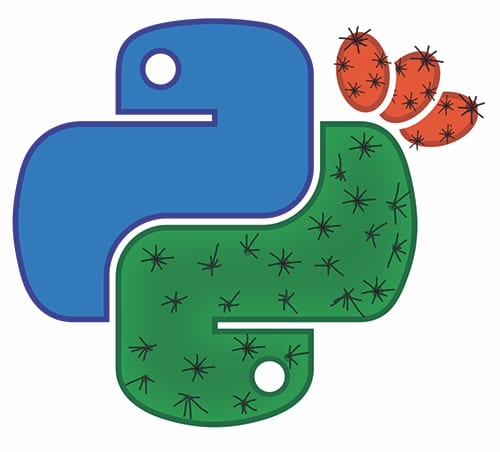
Python publishes no illustration style and the homepage uses none. The only graphic beyond the logo and icons is code. The FAQ shows community logo designs (PyCon Zimbabwe, PyCon Israel, PyCon China) as approved derivatives, which is the nearest thing to an illustration guide.
Source: python.org/psf/trademarks-faq
No photography guidance is published and the homepage carries no photographs.
No photography guidance is published and the homepage carries no photographs. Success stories are text quotes.
| Style | not published |
|---|
Source: python.org/%20(2026-10-31)
Motion is minimal: the hero carousel fades every 8 seconds (slides on touch), dropdowns open after a 0.25s delay, and a published default transition of 0.3s.
| Carousel | fade 600ms every 8000ms |
|---|---|
| Transition | 0.3s (published token) |
| Dropdown delay | 0.25s |
Source: github.com/python/pythondotorg/blob/main/static/css/style.csspython.org/static/js/main-min.b1e587ad1920.jspython.org/static/stylesheets/mq.ab4b4ea88926.css
A fixed 1200px container on every band, a published 12-column Susy grid (60px columns, 20px gutters) rendered as four or two equal widget columns, and a blue header that holds the network bar, logo row, nav, hero and intro in one gradient. Light content sits between blue header and blue footer base.
Measured from python.org's Logo rules from the PSF logo page, trademark policy, trademark FAQ and Python Logo Usage Guidelines PDF v1.0; colour and type tokens from the open-source python.org stylesheet (python/pythondotorg); page anatomy measured on www.python.org at 1440 and 390 with Playwright, 2026-10-31.
| Measure | Desktop | Phone |
|---|---|---|
| Page margin | 144px | 4px |
| Section padding | 40px | 4px |
| Hero text width | max 1096px, centered | full width |
| Card gap | 24px | 24px |
| Navigation | 55px | 55px |
Widget / band title (Flux-Regular)
Flux (Flux Regular / Flux Bold) · 24.15px · line 1.25 · weight 400
Intro line
Source Sans Pro · 24px (phone 20) · line 1.4 · weight 400
Slide heading
Source Sans Pro · 21px · line 1 · weight 700
Main nav item
Source Sans Pro · 18px · line 1.625 · tracking 0.18px · weight 400
Footer base link (Flux-Bold)
Flux (Flux Regular / Flux Bold) · 18.11px (phone 20.7) · line 1.625 · weight 400
Sitemap heading (Flux-Bold)
Flux (Flux Regular / Flux Bold) · 17.5px (phone 20) · line 1.625 · weight 400
Quote
Source Sans Pro · 18px (phone 16) · line 1.75 · weight 400
Body
Source Sans Pro · 16px · line 1.625 · weight 400
Widget text
Source Sans Pro · 15px (phone 16) · line 1.625 · weight 400
Sitemap link / attribution
Source Sans Pro · 14px (phone 16) · line 1.625 · weight 400
Tag
Source Sans Pro · 13.125px (phone 14) · line 1.625 · weight 400
Copyright
Source Sans Pro · 11.9px (phone 10.2) · line 1.625 · weight 400
Code sample
Consolas (system stack) · 16px · line 1.5 · weight 400
How Python’s own landing pages are built, observed on python.org, 2026-10-31. The full measurements are in spec.md.
Source: github.com/python/pythondotorg/blob/b806afadb9ed2e3e8e923678c07d94f649249190/static/sass/_base.scsspython.org/static/stylesheets/mq.ab4b4ea88926.csspython.org/%20(2026-10-31)
How our engine applies Python's system to each format. Our recipe from their published rules and observed site, not something the PSF publishes. Level = how much blue gradient, yellow and prompt marks a format carries (0 plain, 5 full).
| Format | What they did | Source |
|---|---|---|
| Python Powered badge | Wide (200x80 down to 70x28) and tall (140x182 down to 50x65) badges for software built with Python, plus SVG sources. | python.org/community/logos |
| conference logos | Derived logos for PyCons and user groups, approved by the Trademarks Working Group when the outline is kept. | python.org/psf/trademarks-faq |
| merchandise | Non-commercial T-shirts and stickers with the unaltered logo are fine; selling needs permission and a suggested donation. | python.org/psf/trademarks-faq |
| books and courses | Nominative use of the logo; a TM notice in the imprint. | python.org/psf/trademarks-faq |
| PyPI | A related reserved logo maintained by the PSF for the Package Index. | python.org/psf/trademarks-faq |
| Format | Loudness | Must appear | What varies |
|---|---|---|---|
| Landing page | Build it the way www.python.org is built (kit.spec.page, homepage voice): dark network bar with six colour-ruled tabs; blue gradient header with the light-wordmark logo at left, yellow Donate and a dark options bar at right; glossy blue rounded nav; two-panel code carousel at rest on slide 1; centred grey intro with yellow ">>> Learn More"; light content band with a yellow notice, 4-up then 2-up widgets with 4px light-blue rules and Flux titles; blue PSF-style band with yellow buttons and the large device; grey sitemap; blue base | which widgets and how many rows; the code sample shown; the notice (or none) | |
| Docs or guide page | Inner-page shell: same header, Source Sans Bold #3776AB headings, 15px/28px text, sidebar widget in blue; devguide voice | section nav colour by site area (PSF pages use a grey #646565 nav) | |
| Deck | Combined logo with TM, blue gradient title slides, Source Sans Pro, one code sample per idea, yellow for the one action | light content slides | |
| Proposal page | Light ground, #444444 text, #3776AB links, one yellow action; the non-affiliation notice if not the PSF | a code panel when the subject is technical | |
| Event or community page | Unaltered logo or an approved derivative, TM, approval for any derived logo; yellow and blue | decoration inside the snakes that never touches the outline |
Source: python.org/psf/trademarkspython.org/psf/trademarks-faqpython.org/community/logosdevguide.python.org/documentation/style-guide
Your name and logo, Python’s system.
Use this kit for my brand Use this brand in Claude
Get your brand audit Put your brand in Claude What goes in a brand book
Each value is marked published, observed, our reading or our recipe, with its source. Checked 2026-10-31. Not affiliated with Python.