Planet scale
Built on the principles Google uses to run billions of containers a week; scales without a bigger ops team (paraphrase). Published
Brand book
A helm, not a brand campaign. Kubernetes steers by one mark, one blue and a strict, plain writing style, and lets a whole ecosystem build around it. Our reading

Everything visual beyond the logo and the blue: the site's greys, layout, illustration and type are conventions, not rules, and non-commercial uses (t-shirts, stickers) may even modify the mark.
Source: github.com/kubernetes/kubernetes/blob/master/logo/usage_guidelines.mdgithub.com/kubernetes/kubernetes/blob/master/logo/colors.md
Our engine's setting, built from their rules.
Cover the helm. If the page is just white, blue links and Open Sans, it reads as any docs site; the illustrations and the plain, exact copy are what's left of Kubernetes.
For NEW copy: search for just, simply, easy, please, currently, new, e.g., i.e., K8S, cloud-native and open-source, and cut each. A rebuild of the existing homepage keeps its own lines verbatim.
Does anything imply the Linux Foundation, CNCF or Kubernetes endorses a product? Rewrite as '<product> for Kubernetes'.
A portable, extensible, open source platform for managing containerized workloads and services, with declarative configuration and automation (paraphrase). Published
Built on the principles Google uses to run billions of containers a week; scales without a bigger ops team (paraphrase). Published
From a laptop test to a global enterprise, it grows with the application (paraphrase). Published
Open source, so workloads run on-premises, hybrid or public cloud and move where needed (paraphrase). Published
The name is Greek for helmsman or pilot, which is why the mark is a ship's wheel. Google open sourced Kubernetes in 2014 on 15 years of running production workloads (Borg); it is now a graduated CNCF project under the Linux Foundation, written and maintained by the Kubernetes Authors and its SIGs.
Category. Container orchestration Published
Traditional all-inclusive PaaS systems (the overview names what Kubernetes is not).
Kubernetes, also known as K8s, is an open source system that automates deploying, scaling and managing containerized applications. It groups an application's containers into logical units for management and discovery, and builds on 15 years of running production workloads at Google plus the community's best ideas.
Production-Grade Container Orchestration Published
Automated container deployment, scaling, and management Published
The homepage carries the messaging: one title (Production-Grade Container Orchestration), a definition sentence, and three short feature heads (Planet scale, Never outgrow, Run K8s anywhere). No messaging framework is published.
Run the container.
Simply run the container.
A global, volunteer-written project with many second-language readers needs plain, precise, neutral prose that stays true across releases.
DirectPreciseNeutralInclusive
The published voice is SIG Docs' documentation style guide: US English, you not we, present tense, active voice, no idioms, no Latin abbreviations, no words that assume ease, no dated words. CNCF adds the naming rules (K8s, cloud native, open source).
K8scloud nativeopen sourceon-premisesSIG Docs
justsimplyeasyeasilysimplepleasecurrentlynewe.g.i.e.under the hoodK8SK8cloud-nativeopen-sourceon-premisewe (for the project)click here
Source: kubernetes.io/docs/contribute/style/style-guidegithub.com/cncf/foundation/blob/main/style-guide.mdlinuxfoundation.org/legal/trademark-usage
| Spelling | US English |
|---|---|
| Person | you; avoid we |
| Headings | sentence case (body), title case (page title) |
| Quotes | punctuation outside |
| Callouts | Note, Caution, Warning |
Source: kubernetes.io/docs/contribute/style/style-guidekubernetes.io/docs/contribute/style/content-guidegithub.com/cncf/foundation/blob/main/style-guide.md


Official SVGs from cncf/artwork (projects/kubernetes), downloaded 2026-10-30. No file uses currentColor: fills are #326CE5 and #FFFFFF via <style> classes, and the color lockup's wordmark paths are unstyled, so they render black. The SVG groups are id'd its-pronounced and kyoob-cuttle. The kubernetes/kubernetes logo folder also has logo.svg, logo_with_border.svg, name_blue.svg and name_white.svg (saved as k8s-repo-*.svg); name_blue uses #326DE5, a hair off the official blue. Kubernetes is a trademark of the Linux Foundation; shown for reference, not affiliated.
Helmsman in Greek, drawn as a wheel: the name and the mark tell one story.


| Layouts | horizontal, stacked, icon |
|---|---|
| Versions | color, black, white, all blue, white text |
| Formats | PNG, SVG (26 unique) |
| Color | #326CE5 / Pantone 285 C |
| Licence | Apache-2.0 or CC-BY-4.0 |
| Clear space | not published |
| Minimum size | not published |
The logo is a white ship's wheel in a Kubernetes Blue heptagon, plus the lowercase wordmark kubernetes. CNCF ships it in 3 layouts (horizontal, stacked, icon) and 5 versions (color, black, white, all blue, white text) as PNG and SVG: 26 unique files. In the full-color file the wordmark is black; all blue makes it blue; white text makes it white for dark grounds.
Not published: clear space; minimum size; placement.
Source: github.com/kubernetes/kubernetes/blob/master/logo/usage_guidelines.mdgithub.com/cncf/artwork/tree/main/projects/kubernetesgithub.com/kubernetes/kubernetes/blob/master/logo/LICENSElinuxfoundation.org/legal/trademark-usage
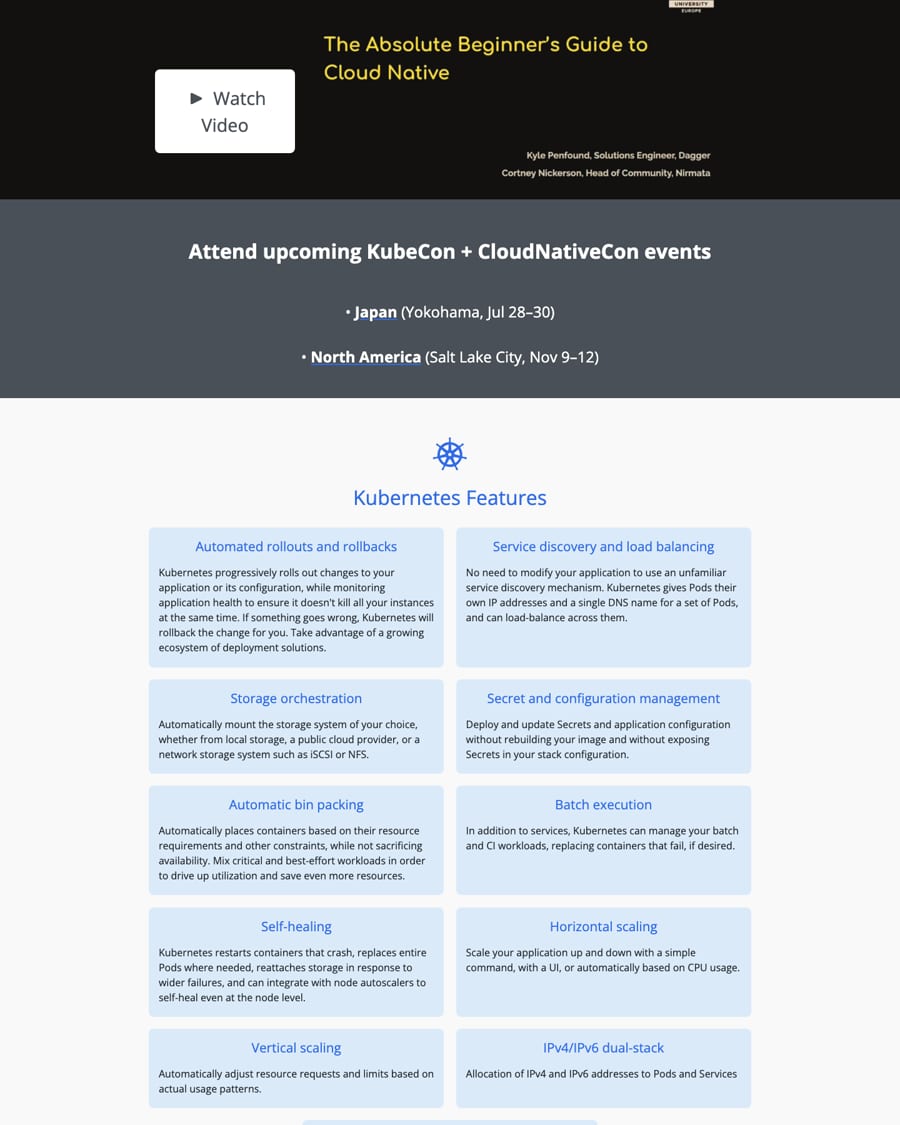
Kubernetes Features
Kubernetes Features
A single blue keeps a community-built, multi-vendor ecosystem recognizable without a design team policing a palette.
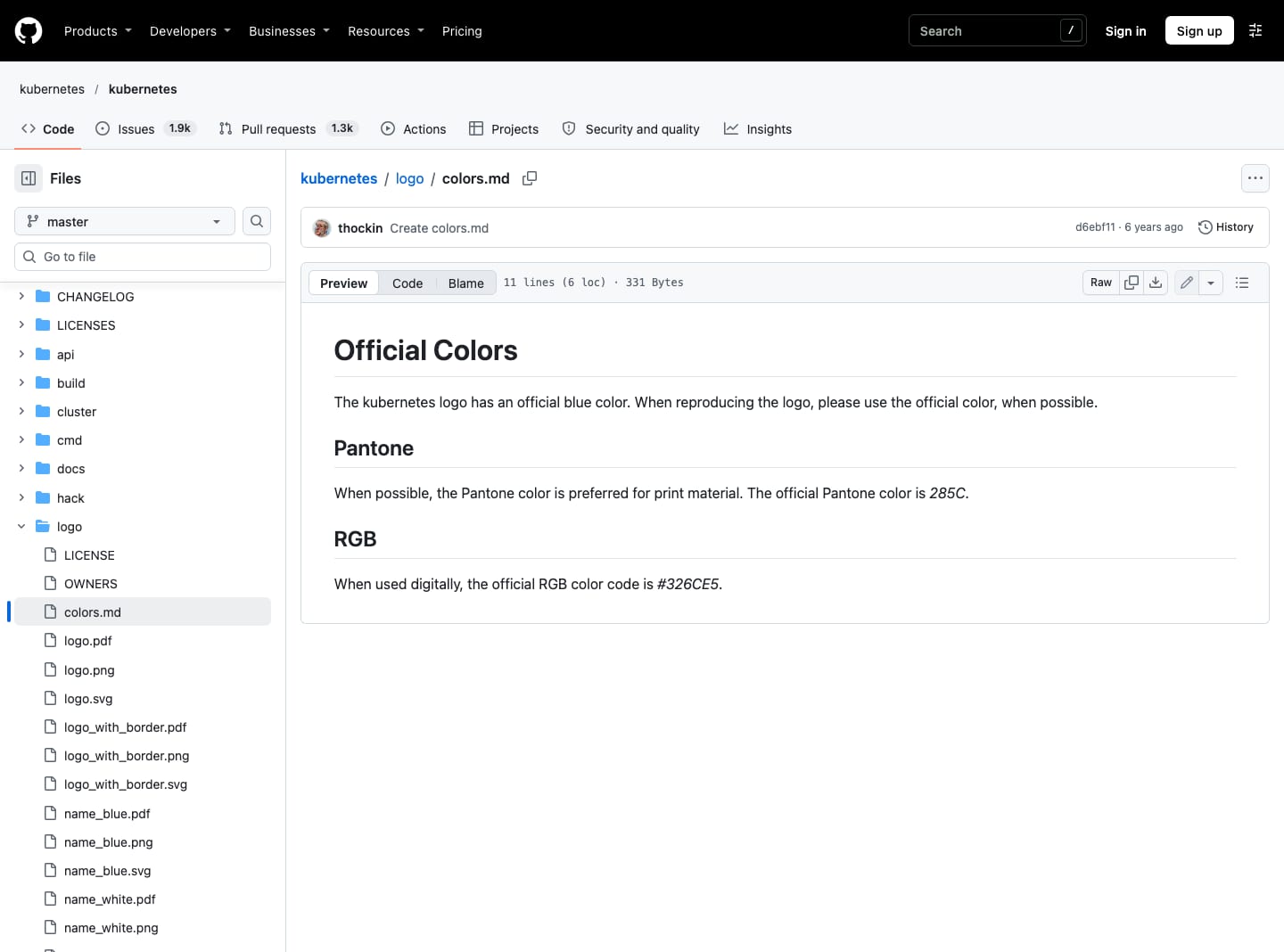
| Official | #326CE5 |
|---|---|
| Pantone 285 C | |
| Site ink | #212529 (observed) |
| Site surface | #F9F9F9 (observed) |
One official color: Kubernetes Blue, #326CE5 on screen and Pantone 285 C in print. Everything else on kubernetes.io is the website's: white pages, #212529 text, Bootstrap greys, light-blue feature cards #DAEAF9, a navy announcement band, dark bands and footer.
Not published: secondary palette; tints; CMYK; proportions; text and background pairings.
Source: github.com/kubernetes/kubernetes/blob/master/logo/colors.mdgithub.com/kubernetes/website/tree/main/assets/scss
Production-Grade Container Orchestration
A neutral, open humanist sans reads well across the dozen-plus languages the docs are translated into.
| Their face | Use | License | Open stand-in |
|---|---|---|---|
| Open Sans | Headings 500-700 on kubernetes.io (observed; no type is published) | Open (SIL OFL 1.1), Google Fonts | none needed |
| Open Sans | Body 400 | Open (SIL OFL 1.1), Google Fonts | none needed |
| System monospace (SFMono-Regular, Menlo, Consolas) | Code | System fonts, not distributed | Roboto Mono The site loads no mono web font; Roboto Mono is our open stand-in for the system stack. |
| Display | Open Sans 500-700 (observed) |
|---|---|
| Body | Open Sans 400 (observed) |
| Mono | system SFMono/Menlo/Consolas stack (observed); Roboto Mono is our stand-in |
| Licence | SIL OFL 1.1 |
No typeface is published. kubernetes.io sets everything in Open Sans (Docsy's default, from Google Fonts at 300/400/700) with a system fallback stack, and code in the system monospace stack.
Not published: typefaces; type scale; weights; tracking.
Source: github.com/kubernetes/website/tree/main/assets/scsskubernetes.io
kubernetes
The helm in a blue heptagon · Every lockup, the favicon, the nav logo, the KubeCon mark, the features-section icon
Run K8s anywhere
One blue, everything else neutral · Site links, buttons, nav hover, illustrations, the logo
Do Flat geometric shapes in Illustration blue #316CE6 and teal #09C1D1 with pale-teal tints; containers as squares and stacks, no outlines, no gradients, no people.
Flat blue-teal technical illustrations · Homepage feature blocks (flower, scalable, blocks, suitcase)
The `kubectl run` command creates a Pod.
Code style inside the sentence · Docs and any technical copy
Specimens use sample copy, not Kubernetes’s.
The wheel is distinctive enough to stand alone.
| Element | helm in heptagon |
|---|---|
| Texture | node-network image on dark bands (observed) |
The helm and its heptagon recur as the only graphic element: the nav logo, the favicon, the KubeCon mark and the small helm above Kubernetes Features. Dark bands carry a faint network-node texture image.
Not published: patterns; textures; grids.
Source: github.com/cncf/artwork/tree/main/projects/kuberneteskubernetes.io
Off-the-shelf icons suit a docs site maintained by volunteers.
| Library | Font Awesome 6 (observed) |
|---|
No icon set is published. The site uses Font Awesome 6 (free and brands) for UI and social icons.
Not published: icon style; grid; stroke.
Source: kubernetes.io
Flat geometry explains abstract infrastructure without people or photos.


| Colors | #316CE6, #09C1D1, #C9E9EC (observed) |
|---|---|
| Style | flat geometric |
Homepage illustrations are flat, geometric SVGs in blue #316CE6 and teal #09C1D1 with pale-teal tints: containers as squares feeding the helm (flower), a four-way scaling diamond, a growing block grid, a hexagon-patterned suitcase.
Not published: illustration guidelines.
Source: kubernetes.io
Not stated.
| Guidance | not published |
|---|
Not published. The homepage shows one video still (a KubeCon talk) and no other photography.
Not published: photography style.
Source: kubernetes.io
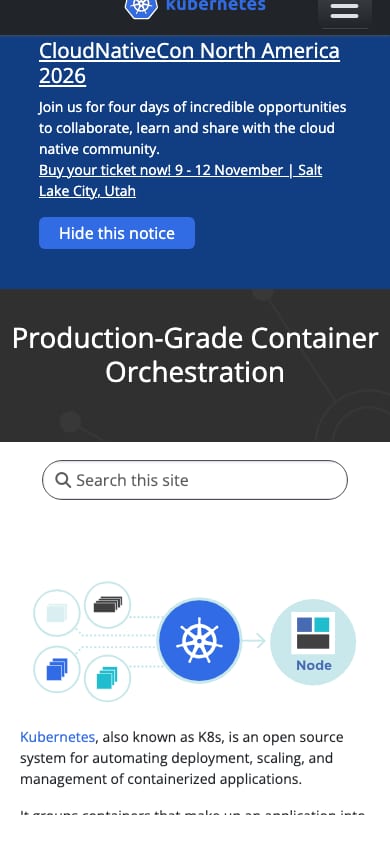
kubernetes.io is a Docsy (Hugo) site on Bootstrap 5: fixed dark nav with the blue logo, an optional navy KubeCon announcement, a dark hero with the h1, a search bar, centered illustrations over left-aligned text, a light-grey feature grid of light-blue cards, a grey events band and a textured dark footer.
Measured from kubernetes.io's Playwright computed styles at 1440 and 390, observed 2026-10-30.
| Measure | Desktop | Phone |
|---|---|---|
| Page margin | 120px | 20px |
| Section padding | 60px | 60px |
| Hero text width | max 1200px, centered | full width |
| Card gap | 20px | 20px |
| Navigation | 64px | 64px |
Features heading (H2 in blue)
Open Sans · 32px (phone 24.71) · line 1.2 · weight 400
Events band H2 (white, bold)
Open Sans · 32px (phone 24.71) · line 1.2 · weight 700
Phone hero H1 (phone only)
Open Sans · 27.85px · line 1.2 · weight 400
Announcement title / section H4
Open Sans · 21.6px (phone 20.6) · line 1.2 · weight 400
Feature card title
Open Sans · 20.8px · line 1.346 · weight 400
CNCF line
Open Sans · 19.2px · line 1.5 · weight 400
Event lines
Open Sans · 24px · line 1.5 · weight 400
Feature card body
Open Sans · 16px · line 1.5 · weight 400
Overview body / announcement body / footer legal
Open Sans · 14px · line 1.5 · weight 400
Nav link
Open Sans · 14px · line 1.5 · weight 700
How Kubernetes’s own landing pages are built, observed on kubernetes.io, 2026-10-30. The full measurements are in spec.md.
Source: kubernetes.io/docs/contribute/style/style-guidegithub.com/kubernetes/website/tree/main/assets/scsskubernetes.io
How our engine applies Kubernetes' system to each format. This is our recipe built from their rules and the site, not something Kubernetes publishes. Level = how much blue and illustration the format carries (0 plain, 5 full).
| Format | What they did | Source |
|---|---|---|
| website | kubernetes.io: docs-first Docsy site, dark nav, search, flat illustrations, light-blue feature cards. | kubernetes.io |
| documentation | Docs in 15+ languages written to the SIG Docs style guide with Note/Caution/Warning callouts. | kubernetes.io/docs/contribute/style/style-guide |
| events | KubeCon + CloudNativeCon announcements in a navy band with the KubeCon/CloudNativeCon lockup. | kubernetes.io |
| merch | T-shirts, hoodies and stickers via the CNCF store; non-commercial modification of the mark is permitted. | github.com/cncf/artwork/tree/main/projects/kubernetes |
| Format | Loudness | Must appear | What varies |
|---|---|---|---|
| Landing page | Build it the way kubernetes.io is built (kit.spec.page): a fixed 64px nav, transparent over a navy #113E82 announcement band at the top (#212529 once scrolled), with the white-text horizontal lockup, a pill search, flat blue-teal illustrations centred over left-aligned 14px Open Sans copy on white, the #F9F9F9 feature grid of #DAEAF9 cards, a textured dark footer. Plain institutional homepage voice | which sections; whether a navy announcement band runs; how many feature cards | |
| Docs page | Sentence-case headings, you and present tense, UpperCamelCase API kinds, code style for commands, Note/Caution/Warning callouts | length and depth | |
| Deck | Official lockup, white or dark grounds, Kubernetes Blue as the only accent, Open Sans | illustrations; one blue title slide | |
| Social post | Icon or horizontal lockup unaltered, one blue, plain line in K8s naming | blue ground with the white lockup | |
| Third-party product page | "<product> for Kubernetes" naming, trademark notice, your own brand more prominent | none on the mark | |
| Swag | Non-commercial only if the mark is modified | playful variations of the helm |
Source: github.com/cncf/foundation/blob/main/style-guide.mdlinuxfoundation.org/legal/trademark-usagekubernetes.io/docs/contribute/style/style-guide
Your name and logo, Kubernetes’s system.
Use this kit for my brand Use this brand in Claude
Get your brand audit Put your brand in Claude What goes in a brand book
Each value is marked published, observed, our reading or our recipe, with its source. Checked 2026-10-30. Not affiliated with Kubernetes.